
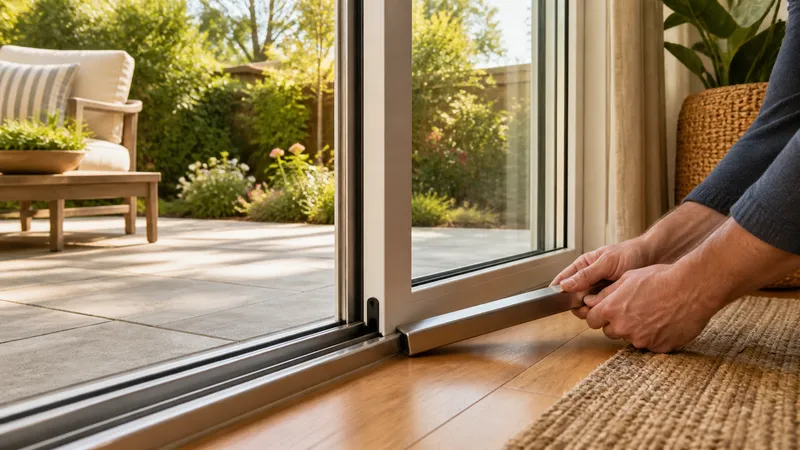
How to secure sliding glass doors with a track bar, anti-lift blocks, and a pin lock, plus which fixes stop prying versus lifting the door off track.
Key takeaways
- A metal or wood bar cut to fit the bottom track (a 'Charlie bar') stops the door from sliding open even if the factory latch is defeated.
- Anti-lift blocks or screws in the top track stop burglars from lifting the panel out of its track, a separate technique from prying the latch.
- A hardened steel pin through the door frame into the fixed frame stops the panel from being forced off track entirely.
- The factory thumb-latch alone is not a security device; it's designed to keep the door from drifting open, not to resist force.
- FBI crime data groups roughly a third of burglaries as unlawful entry with no force at all, so an unlocked slider is as much risk as a weak lock.
- Add a monitored door or glass-break sensor as a detection layer; physical blocks stop or slow entry, sensors get someone responding faster.
Securing a sliding glass door takes three layered fixes, not one: a bar or dowel in the bottom track to stop the door from sliding open, anti-lift blocks or screws in the top track to stop the panel from being lifted out, and a pin lock through the frame to stop it from being forced off the track entirely. The factory thumb-latch alone is not a security device — it keeps the door from drifting open in the wind, but it isn’t built to resist prying, and sliding doors are a known target because of that gap.
Sliding door security fixes at a glance
| Fix | What it stops | Typical cost (2026) | DIY or pro |
|---|---|---|---|
| Track bar (“Charlie bar”) | Door sliding open even if the latch is defeated | $15-$40 | DIY — cut or adjust to fit the track, no drilling required |
| Anti-lift blocks/screws in top track | Panel being lifted up and out of the track | $10-$25 | DIY — a few screws driven into the top track to reduce vertical play |
| Patio door pin lock | Panel being forced along the track after the latch fails | $10-$20 | DIY with care — requires drilling through the frame at the correct angle |
| Shatter-resistant security film | Fast entry by breaking the glass | $150-$400 installed for a standard slider, more for large or specialty glass | DIY kits exist but professional install avoids bubbling and edge lift |
| Monitored door/glass-break sensor | Detection and response time, not physical entry | $20-$60 per sensor, plus monitoring fees if using a professional alarm service | DIY for most smart-home sensors; professional install for a monitored system |
Why sliding doors are a target
Nationwide crime data consistently shows that a meaningful share of burglaries involve no forced entry at all — the FBI’s Uniform Crime Reporting program has classified roughly a third of burglary offenses as unlawful entry rather than forcible entry in recent reporting years, meaning the door or window simply wasn’t secured (FBI UCR: Burglary). Sliding glass doors compound that risk two ways: the factory latch is a lighter mechanism than a deadbolt, and an older or worn track gives the panel enough vertical play to be lifted out rather than unlocked.
Installing a track bar and anti-lift blocks
- Measure the bottom track’s length when the door is fully closed.
- Cut a metal or hardwood dowel to fit snugly — it should sit in the track without so much slack that it can be jarred loose, and without being so tight it won’t seat.
- Drop the bar into the track behind the sliding panel.
- In the top track, drive two or three screws (long enough to bite the frame but not so long they hit the glass) so their heads sit just above the panel’s travel path, leaving enough clearance for the door to slide but not enough to lift it out.
Installing a patio door pin lock
With the door closed, drill a hole at a slight downward angle through the sliding panel’s frame, continuing partway into the fixed frame behind it — check the pin manufacturer’s depth guidance so you don’t drill through the fixed frame or into the glass. Insert the hardened steel pin. Most kits include a second, higher hole so you can ventilate the door slightly (cracked open a few inches) while still pinning it against being slid further or lifted.
Caveats: door age, glass type, and climate
| Situation | What changes |
|---|---|
| Older aluminum-frame slider | Tracks wear faster and develop more lift-off play; anti-lift hardware matters more on an older door |
| Tempered vs. laminated glass | Laminated glass (or added security film) resists shattering better than standard tempered glass, which is designed to crumble safely rather than resist impact |
| Coastal or high-wind area | Impact-rated glass or film installed for storm protection often adds meaningful forced-entry resistance as a side benefit |
| HOA or historic-district rules on exterior hardware | Confirm visible modifications (film tint, exterior sensors) are allowed before installing |
When to call a professional
| Situation | Why it’s not DIY |
|---|---|
| Track is bent, warped, or the door doesn’t glide smoothly | A door/window installer should repair or replace the track before you add security hardware to it |
| You want impact-rated or laminated replacement glass | That’s a glazier job — matching thickness, tint, and frame compatibility isn’t a retrofit |
| Installing a monitored alarm system tied to the door | A licensed alarm installer can wire and register sensors correctly with a monitoring service |
| The door frame shows rot, rust, or the fixed panel isn’t secure in the frame | A contractor should address the frame itself; hardware added to a failing frame won’t hold |
Related guides
Frequently asked questions
What is a Charlie bar and does it actually work?
A Charlie bar (also called a security bar or dowel bar) is a metal or wood rod cut to fit snugly in the door’s bottom track when the door is closed. It physically blocks the sliding panel from moving, so even if someone defeats the latch, the door can’t slide open. A properly fitted steel bar is harder to defeat than a wood dowel, which can splinter or be forced under enough pressure.
How do burglars actually get through a sliding glass door?
The two common techniques are prying or shimming the latch open, and lifting the door panel up and out of its track, since older sliders have enough vertical play to be lifted off the track rails. A security bar stops the first method; anti-lift blocks or screws in the top track stop the second. Breaking the glass itself is less common because of the noise, but shatter-resistant film addresses that risk too.
What is a patio door pin lock and how do I install one?
A pin lock is a hardened steel pin inserted through a hole drilled at a slight downward angle through the sliding panel’s frame and partway into the fixed door frame behind it. It physically pins the two frames together so the sliding door can’t be forced along the track even with the latch broken. It’s a straightforward drill-and-insert job, but measure carefully so the hole doesn’t go all the way through the fixed frame or hit the glass.
Do I need to replace my sliding door locks or can I add security to the existing one?
In most cases you can add security without replacing the door: a track bar, anti-lift screws, and a pin lock are all retrofits that work with the existing hardware. Replace the factory latch only if it’s broken, doesn’t catch reliably, or the door is old enough that the track itself is worn and letting the panel rattle loose.
Are sliding glass doors less secure than swinging doors?
Not inherently, but the factory latch on most sliders is a lighter-duty mechanism than a deadbolt, and the track design creates the lift-off vulnerability a hinged door doesn’t have. With a track bar, anti-lift hardware, and a pin lock added, a sliding door can be as resistant to forced entry as a standard door with a deadbolt.