
EPA guidance on who should test for radon, how DIY test kits work, and the step-by-step process for a reliable result in your home.
Key takeaways
- The EPA recommends every home be tested for radon regardless of zone, age, or whether neighbors tested low.
- A short-term charcoal kit (2-90 days) or a long-term alpha-track kit (90+ days) both work; long-term gives a more reliable year-round average.
- Place the test device on the lowest lived-in level, at least 20 inches off the floor and 3 feet from windows, doors, and vents.
- Test kits run about $15-$25 at hardware stores, or ask your state radon program about free kits.
- Close windows and doors as much as normal living allows for the 48 hours before and during a short-term test for an accurate reading.
Yes — the EPA recommends that every home be tested for radon, regardless of its location, age, or construction type, because radon levels vary house to house even within the same neighborhood (EPA: A Citizen’s Guide to Radon). Testing is inexpensive and something almost any homeowner can do themselves with a $15-$25 kit and a few weeks of patience — you don’t need to already suspect a problem, and you don’t need a contractor to find out.
Who should test — the short answer
| Situation | Should you test? |
|---|---|
| Any home, any zone, no prior test | Yes — EPA recommends testing regardless of zone map designation |
| Buying or selling a home | Yes — many lenders and contracts specify testing during the transaction; use a certified tester if the contract requires it |
| You tested years ago | Yes, retest — EPA suggests retesting every 2 years, and always after any renovation that touches the foundation, HVAC, or ventilation |
| Neighbor’s house tested low | Test anyway — radon can vary significantly between adjacent homes because of differences in soil gas paths and foundation cracks |
| You just finished a basement remodel | Yes — new finished living space changes airflow and occupancy in the lowest level, which changes your exposure |
The two DIY test types
| Test type | Duration | Best for | Cost |
|---|---|---|---|
| Short-term (charcoal canister) | 2-90 days, most commonly 2-7 days | A quick initial screen or a real estate deadline | ~$15-$25 including lab fee |
| Long-term (alpha-track) | 90+ days | A representative year-round average before deciding on mitigation | ~$20-$30 including lab fee |
The EPA’s recommended sequence: run a short-term test first. If the result comes back at 4 pCi/L or higher, follow up with either a long-term test or a second short-term test before deciding on mitigation (EPA Citizen’s Guide to Radon). A single short-term result is a screen, not a verdict — radon readings shift with weather, barometric pressure, and how tightly the house is closed up that week.
How to run the test correctly
- Pick the location. Use the lowest level of the home that’s regularly lived in — a finished basement family room counts; an unused crawlspace or unfinished storage area does not, unless that’s genuinely the lowest occupied space.
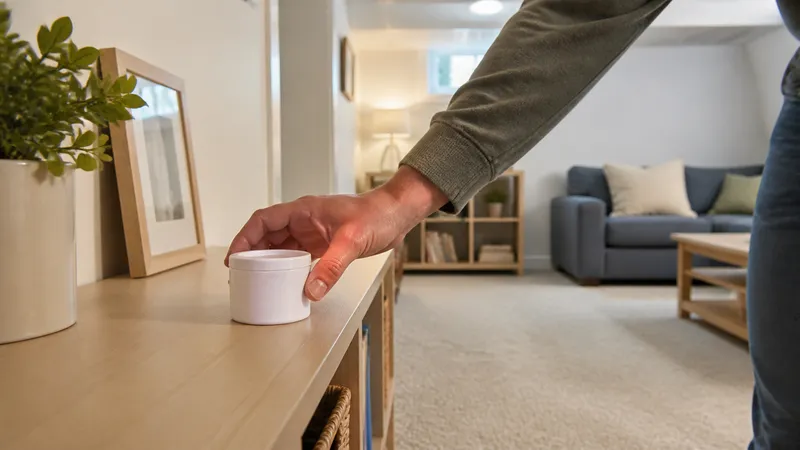
- Position the device. At least 20 inches above the floor, at least 3 feet from exterior doors and windows, away from drafts, direct sunlight, and high humidity (skip bathrooms and laundry rooms).
- Close up the house. For a short-term test, keep windows and exterior doors closed as much as normal living allows, starting about 12 hours before you start the test and through the full test period. Don’t run the test during unusually high winds or storms if you can help it — that skews the reading.
- Leave it alone for the full period. Don’t move the device, and don’t test during a period when you’re doing unrelated construction, painting, or major HVAC changes.
- Send it to the lab and read the result. Most kits include a prepaid mailer to a lab; results typically arrive by mail or email within a couple of weeks.
Free and low-cost testing options
Many state radon programs distribute free or discounted test kits, and some offer them by mail. Check your state’s program through the National Radon Program Services directory before buying a kit online or at a hardware store — you may not need to pay at all. If your situation requires a certified result (a real estate contract, for instance), search the National Radon Proficiency Program or your state’s certified tester list rather than relying on a self-administered kit, since some contracts specifically require a third-party measurement professional.
When to call a professional
| Situation | Why it’s not DIY |
|---|---|
| A real estate contract requires a certified radon test | Use a state-certified radon measurement professional; a self-test may not satisfy the contract or lender requirement |
| Your short-term result comes back at or above 4 pCi/L | Bring in a certified radon professional for confirmatory testing and, if needed, mitigation system design — see the next article for the full decision path |
| You want a continuous monitor instead of a mail-in kit | A certified tester can place and read an electronic continuous radon monitor, which gives day-by-day data instead of a single averaged number |
| Structural issues (major foundation cracks, sump pit without a sealed cover) complicate testing or mitigation | A radon mitigation contractor can evaluate the foundation before and alongside a fix |
Related guides
Frequently asked questions
Does everyone need to test for radon, even outside high-risk zones?
Yes. The EPA recommends testing every home regardless of its EPA radon zone designation, because radon levels vary house to house even on the same street due to differences in foundation, soil gas paths, and construction. A zone map estimates county-level averages; it doesn’t tell you what’s in your specific basement.
What’s the difference between a short-term and long-term radon test?
A short-term test (2-90 days, most commonly a 2-7 day charcoal canister) gives a quick snapshot and is useful for an initial screen or a real estate transaction deadline. A long-term test (more than 90 days, typically alpha-track) averages out seasonal and weather swings and gives a more representative year-round number, which is what the EPA recommends before deciding on mitigation.
Can I do a radon test myself, or do I need a professional?
You can test yourself with an over-the-counter or mail-order kit; DIY testing is EPA-endorsed and reliable if you follow the placement and timing instructions on the package. A hire-out option is a state-certified radon measurement professional, which some mortgage lenders or real estate transactions require instead of a homeowner-administered kit.
Where exactly should I put the radon test device?
In the lowest level of the home that’s regularly used or lived in — a finished basement counts, an unused crawlspace doesn’t. Set it at least 20 inches above the floor, away from drafts, at least 3 feet from windows, exterior doors, and vents, and out of direct sunlight or high humidity like a bathroom.
How much does a radon test kit cost?
A short-term charcoal kit typically runs $15-$25 at a hardware store or online, including lab analysis. Many state radon programs offer free or discounted kits — check your state’s program through the National Radon Program Services directory before buying one.