
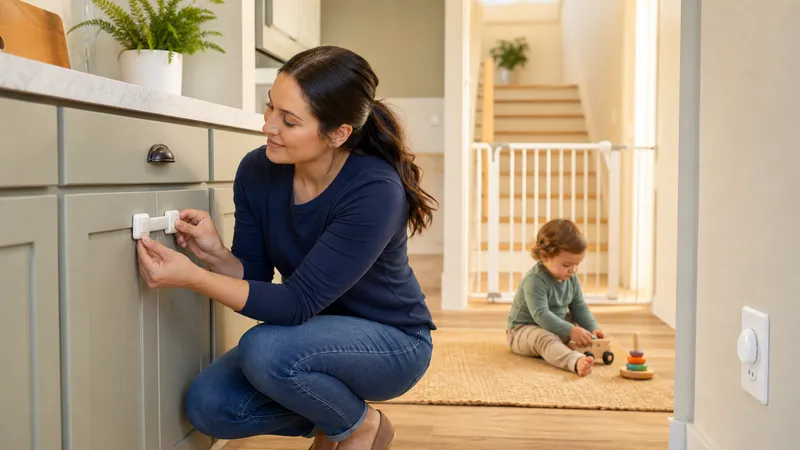
A room-by-room childproofing plan for outlets, cabinets, and stairs, staged by age from crawling through preschool, with CPSC-sourced safety devices.
Key takeaways
- Start before crawling: outlets, cords, and tip-over anchoring should be done by around 4-6 months, not after a fall.
- Use outlet covers or shutters rated for the outlet type; sliding shutters built into the receptacle beat push-in caps a toddler can pull out.
- Cabinet and drawer latches matter most where cleaners, medicine, knives, or plastic bags are stored, not every cabinet in the house.
- CPSC's mandatory gate standard (16 CFR Part 1239, based on ASTM F1004) requires gates labeled for top-of-stairs use to be hardware-mounted, not pressure-mounted.
- Furniture and TV tip-overs killed 459 children 17 and under from 2000-2018, and 93% of those deaths were children 5 and younger, per CPSC's Anchor It data.
- Re-check the house at each mobility milestone: rolling, crawling, cruising, walking, and climbing all open new hazards.
Childproofing outlets, cabinets, and stairs is staged by mobility, not birthday: cover outlets and anchor furniture before a baby crawls (around 4-6 months), latch cabinets and gate stairs once they cruise or climb (around 8-10 months), and shift toward supervised rules instead of hardware once a child reliably follows instructions (around age 3-4). The U.S. Consumer Product Safety Commission’s childproofing guidance groups the highest-risk fixes into a short list: outlet covers, cabinet and drawer latches, corner bumpers, anti-scald devices, and window-cord safety tassels — most cost $20 or less per device (CPSC: Childproofing Your Home).
Childproofing by age and mobility stage
| Stage | Typical age | Priority fixes | Why now |
|---|---|---|---|
| Pre-mobile | Birth-4 months | Anchor furniture and TVs, tie up window blind cords, set water heater to 120°F | Nothing to chase yet, but items above a future crib or changing table become reachable fast |
| Crawling | 4-9 months | Outlet covers/shutters, cabinet latches on chemicals and medicine, gate the stairs | CPSC tip-over data shows fatalities cluster in children 5 and under; crawling is when floor-level hazards become accessible |
| Cruising/walking | 9-18 months | Hardware-mount top-of-stairs gate, corner bumpers, door knob covers, toilet lid locks | Standing height reaches counters and door handles; falls down stairs increase sharply once a child can pull to stand |
| Climbing/toddler | 18 months-3 years | Furniture anchors re-checked (climbers test them), stove knob covers, cabinet locks on knives and bags | Toddlers climb anchored furniture and open latches by trial and error; re-verify hardware annually |
| Preschool | 3-5 years | Transition from hardware to supervised rules for lower-risk items; keep gates/latches on medicine, chemicals, guns | Most 3-5 year-olds understand “don’t touch,” but CPSC’s own data shows the majority of tip-over deaths still occur under 5 |
Outlets: shutters beat plug caps
Tamper-resistant receptacles (TRRs) — required by electrical code in most new construction since 2008 — have spring-loaded shutters built into the outlet itself, so both slots stay blocked unless something is inserted into both simultaneously. If your outlets predate that code, add sliding-shutter cover plates rather than small push-in plastic caps: caps are easy for a toddler to pry out with a fingernail and are themselves a choking hazard once removed (CPSC: Childproofing Your Home). Also unplug and store small appliances (curling irons, chargers) rather than leaving cords dangling within reach of a highchair or crib.
Cabinets: latch by what’s inside, not by location
Not every cabinet needs hardware. Prioritize latches on:
- Cleaning chemicals, laundry pods, and pesticides
- Medicine, vitamins, and alcohol
- Knives, matches, and plastic bags
- The cabinet under the sink and the trash can
Adhesive-mounted magnetic locks and spring latches both work; CPSC’s guidance emphasizes choosing a latch adults can operate reliably one-handed but a child cannot defeat by pulling or prying (CPSC: Childproofing Your Home). Lower cabinets that hold only pots, plastic containers, or linens are lower priority — some parents leave one “yes cabinet” unlatched on purpose so a toddler has something to explore.
Stairs: hardware-mounted gates at the top, no exceptions
Baby gates sold in the U.S. must meet CPSC’s mandatory standard, based on ASTM F1004, codified at 16 CFR Part 1239. That standard restricts which gates can be labeled for top-of-stairs use: pressure-mounted gates (the kind that wedge between walls with a tension bar and no screws) are not approved for the top of a stairway because they can be pushed loose from the wall (CPSC: Gates and Enclosures business guidance). Use a hardware-mounted gate — screwed into the wall studs or banister — at the top of every stairway a crawling or cruising child can reach. A pressure-mounted gate is acceptable at the bottom of the stairs, where a fall against it is a shorter drop.
Caveats: house type and rental limits change the plan
| Situation | What changes |
|---|---|
| Rented home / no drilling allowed | Ask the landlord about anti-tip straps that mount into studs; some tip-over kits use adhesive or clamp-style anchors as a stopgap, but a strap into a stud is stronger — get written permission before drilling if the lease requires it |
| Open staircase with vertical rails | Check the gap between balusters; CPSC uses the same roughly 4-inch (about the width of a soda can) spacing guidance used for deck and stair railings to prevent a child’s head or body from passing through |
| Multi-story or split-level home | Every stairway landing needs its own gate decision — a mid-level landing is not automatically safer than a full flight |
| Older home with non-grounded outlets | Tamper-resistant retrofit receptacles still work on two-prong circuits; consult an electrician if outlets feel loose or warm, which is a separate wiring issue, not a childproofing one |
When to call a professional
| Situation | Why it’s not DIY |
|---|---|
| Outlets feel warm, loose, or spark when plugging in | That’s a wiring or receptacle fault, not something a childproof cover fixes — call a licensed electrician |
| Stairway railing is loose, missing balusters, or structurally unsound | A carpenter or contractor should repair the structure before a gate is mounted to it |
| Furniture anchor point has no stud or the wall is plaster/masonry | An installer or contractor can identify the correct anchor hardware for the wall type |
| You’re unsure whether a gate is rated for top-of-stairs use | Check the CPSC-required label; don’t guess with a stairway drop involved |
Related guides
Frequently asked questions
What age should I start childproofing my home?
Start by around 4-6 months, before a baby is mobile. Outlet covers, cord management, and furniture anchoring are easiest to install before a child can reach or pull on them, and CPSC tip-over data shows most fatalities involve children 5 and under, so early anchoring matters more than any single later fix.
Are outlet covers or outlet shutters safer?
Built-in sliding shutters, either factory-installed tamper-resistant receptacles or a shutter-style cover plate, are safer than small push-in plastic caps. Caps can be pulled out by a toddler and are a choking hazard on their own; tamper-resistant outlets (now code-required in most new construction) block both slots simultaneously unless a plug is inserted into both at once.
Do I need a safety gate at the top and bottom of the stairs?
Yes, once a child starts crawling or cruising. Use a hardware-mounted gate at the top of any stairway; CPSC’s mandatory standard specifically restricts pressure-mounted gates from being labeled for top-of-stairs use because they can be pushed loose. A pressure-mounted gate is acceptable at the bottom.
How do I know if a cabinet needs a childproof latch?
Prioritize cabinets holding cleaning chemicals, medicine, alcohol, knives, plastic bags, or the trash can, plus any cabinet near a stove or a heavy stack of dishes. Cabinets with only pots, plastic containers, or towels are lower priority and can often stay unlocked once a child is old enough to understand a rule.
Is furniture anchoring really necessary if I don’t have a big TV?
Yes. CPSC’s Anchor It data covers dressers, bookcases, and other furniture, not just TVs, and dressers are involved in a large share of tip-over deaths because children climb them to reach items on top. Anchor any freestanding furniture over about 30 inches tall to a wall stud with an anti-tip strap or bracket.