
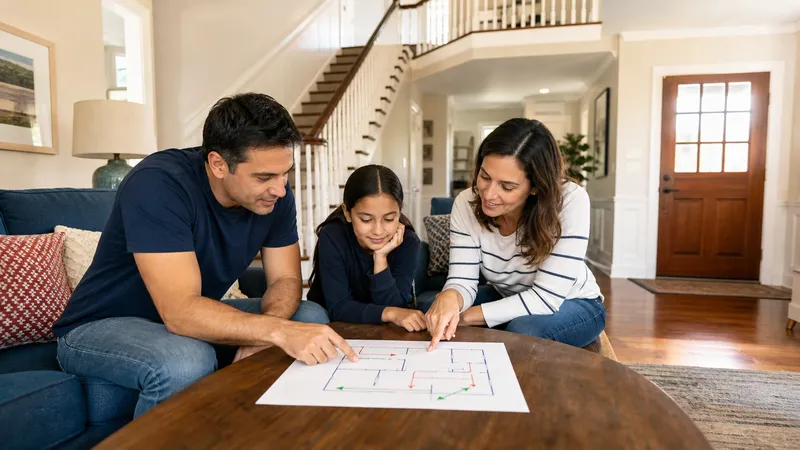
USFA and Ready.gov guidance for building a two-story fire escape plan: two ways out per room, upstairs windows, and a twice-a-year drill.
Key takeaways
- Map two ways out of every upstairs room—usually the bedroom door plus a window—before you need either one.
- Keep a UL-listed collapsible escape ladder in or near each upstairs bedroom that doesn't have a second safe exit.
- Pick one outside meeting place a safe distance from the house and make it non-negotiable, not improvised in the moment.
- Practice the full drill at least twice a year, including at least once with the lights off to simulate low visibility.
- Close doors behind you as you leave each room—it slows fire and smoke spread and buys time for anyone still inside.
A fire escape plan for a two-story house needs two things a one-story plan doesn’t: a real second way out of every upstairs room, and a plan for getting down safely when the stairs aren’t an option. Ready.gov’s core guidance — two ways out of every room, a fixed outside meeting place, and drills at least twice a year — applies to any house, but the upstairs window becomes the make-or-break element on a second floor (Ready.gov: Practice Your Home Fire Escape Plan). The plan only works if it’s practiced before smoke and low visibility make the stairs the wrong choice.
The plan, room by room
| Room | Primary way out | Second way out | What to prepare in advance |
|---|---|---|---|
| Upstairs bedroom (window ≈10-25 ft up) | Bedroom door to hallway/stairs | Window plus a UL-listed collapsible escape ladder | Store the ladder in or near the room; practice deploying it in daylight |
| Upstairs bedroom over a porch or lower roof | Bedroom door to hallway/stairs | Window onto the adjacent roof, then to the ground | Confirm the roof section is safe to stand on and know the path to the ground from there |
| Main-floor bedroom | Bedroom door | A window low enough to exit without a ladder | Confirm the window opens fully and isn’t painted or nailed shut |
| Any room with a security bar or grille on windows | Door | Window, only if the bars have a quick-release mechanism | Install and test quick-release hardware; a fixed security bar with no release removes the second exit entirely |
Two ways out of every room
Walk each upstairs room and identify two ways out — almost always the bedroom door plus the window. If a bedroom’s only path to the stairs could be blocked by fire (for example, a hallway fire between the bedroom and the stairwell), the window is not a backup, it’s the plan. For windows roughly one story up (about 10-25 feet, typical for a second floor), USFA and manufacturers point to a UL-listed collapsible escape ladder as the safe second exit — not knotted sheets, extension cords, or anything improvised in the moment (USFA: Every Second Counts, Plan 2 Ways Out). Store the ladder in or near the room it serves, and have every capable household member practice hooking it to the sill and climbing down in daylight, not for the first time during an actual fire.
Choose and agree on a meeting place
Pick one fixed, specific outside point — a particular tree, the mailbox, a neighbor’s driveway across the street — that’s far enough from the house to be clear of arriving fire trucks and close enough that kids and older household members can reach it on foot. Everyone commits to this single spot every time, not “wherever seems safe” decided in the moment. Once everyone regroups there, someone calls 911 from outside; no one goes back inside for pets, phones, or belongings.
Practice the drill at least twice a year
| Drill element | What to actually do |
|---|---|
| Trigger the alarm | Push the smoke alarm test button so everyone hears and recognizes the sound, not just the household member who usually tests it |
| Use the real route | Each person exits by their planned primary route; alternate the drill so upstairs occupants also practice their window/ladder route periodically |
| Simulate low visibility | Run at least one drill per year with lights off, encouraging household members to crawl low and feel for the door before opening it |
| Time it | Everyone should reach the outside meeting place in well under two minutes — Ready.gov notes a home fire can become life-threatening within two minutes of ignition |
| Debrief | Talk through what was confusing or slow, and adjust the plan rather than just repeating it unchanged |
Ready.gov recommends practicing the escape plan at least twice a year, and treating it as seriously as a school fire drill — with sound cues, a real route, and a real meeting point, not a walkthrough discussion at the dinner table (Ready.gov: Practice Your Home Fire Escape Plan).
When to call a professional
| Situation | Why it’s not DIY |
|---|---|
| Upstairs windows are painted shut, nailed shut, or won’t open fully | A contractor or handyperson should fix window operation before the room can rely on it as a second exit |
| Security bars or grilles have no quick-release mechanism | A licensed installer should add code-compliant quick-release hardware — a fixed barred window with no release is a life-safety issue, not a security feature to leave alone |
| You’re unsure whether a roof section near an upstairs window is safe to stand on | Have a contractor or roofer assess the surface and slope before including it in the plan |
| An active fire is in progress | Call 911 immediately — evacuate using the plan, don’t attempt to fight a fire that’s spread beyond its point of origin |
Related guides
Frequently asked questions
How do you plan a fire escape route for an upstairs bedroom with no second door?
The window becomes the second way out. For a true second story (roughly 10-25 feet up), that means a UL-listed collapsible escape ladder stored in or near that bedroom, not a knotted sheet or an untested homemade solution. Practice hooking and deploying the ladder in daylight before it’s ever needed in smoke.
How often should a family practice a home fire drill?
Ready.gov recommends practicing the full home fire escape plan at least twice a year. Run it like a real drill: someone triggers the smoke alarm test button, everyone uses their planned route, and the household regroups at the outside meeting place. Doing at least one drill with reduced visibility (lights off, eyes closed while feeling for the door) builds the habit for actual smoke conditions.
Why do fire safety guides say to close doors while escaping?
A closed door slows the spread of fire, heat, and smoke into that room, buying time for anyone who hasn’t gotten out yet and limiting how fast the fire grows before help arrives. USFA and fire departments teach “close before you doze” for bedroom doors at night and “close as you go” while evacuating a room during a fire.
What should the outside meeting place be for a two-story house?
A fixed, specific point a safe distance from the house that’s visible and easy for kids to identify quickly, such as a specific tree, mailbox, or a neighbor’s driveway across the street. It should be far enough that it’s not in the path of arriving fire trucks and close enough that everyone can walk there. Agree on it in advance so no one wastes time deciding during an actual fire.
How fast do you actually need to get out during a house fire?
Ready.gov notes a home fire can become life-threatening in as little as two minutes, and modern home furnishings burn faster and hotter than older furniture did, giving households less escape time than in past decades. The goal of practicing your plan is getting everyone to the meeting place in under two minutes, not stopping to gather belongings.