
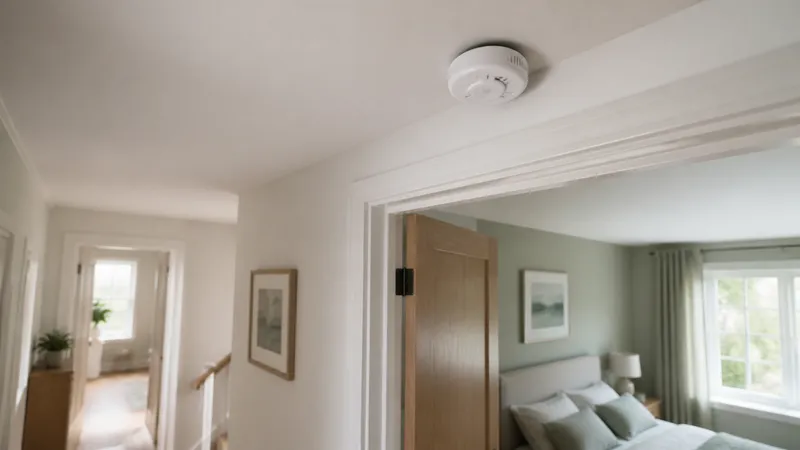
CPSC and NFPA guidance on where to install CO alarms: on every level, outside sleeping areas, and inside bedrooms with fuel-burning appliances.
Key takeaways
- Install a CO alarm on every level of the house and outside each separate sleeping area, per CPSC guidance.
- Put an alarm within roughly 10-15 feet of bedroom doors so it's loud enough to wake a sleeper.
- If a fuel-burning appliance sits inside a bedroom or its attached bathroom, install a CO alarm inside that room too.
- Don't mount CO alarms in kitchens, garages, or directly above fuel-burning appliances—false alarms and short device life follow.
- This page covers placement and count only; alarm testing and 10-year replacement schedules live in the seasonal cluster.
A carbon monoxide alarm belongs on every level of your home and outside each separate sleeping area — that’s the U.S. Consumer Product Safety Commission’s core placement rule, and it’s echoed in NFPA 72 and the International Residential Code, which both require a CO alarm in the immediate vicinity of bedrooms (CPSC carbon monoxide fact sheet). For a typical house, that usually means one alarm on the main floor, one on any upper floor with bedrooms, and one in the basement or lowest level if it’s a fuel-burning appliance space — not a single unit near the front door.
Where each alarm goes
| Location | Placement rule | Why |
|---|---|---|
| Outside each sleeping area | Within roughly 10-15 feet of bedroom doors, in the hallway | Loud enough to wake a sleeper; required by NFPA 72 and most residential codes (CPSC) |
| Every level of the home | At least one per floor, including a finished or lived-in basement | CO can accumulate on any level depending on the source and airflow |
| Inside a bedroom with a fuel-burning appliance | A dedicated alarm inside that specific room | Where a heater, fireplace, or attached bathroom water heater sits inside a sleeping room, code requires an alarm in that room, not just the hallway |
| Near (not above) an attached garage entry | In the hallway or room just inside the door from the garage | Vehicle and generator exhaust are common CO sources that enter through that door |
How many you actually need
Count your sleeping clusters, not your bedrooms. If all the bedrooms open onto one hallway, one alarm in that hallway covers the group. If bedrooms are split across a wing, a finished basement, or opposite ends of the house, each cluster needs its own alarm outside it, plus the one-per-level minimum. A single-level, three-bedroom home with all bedrooms off one hallway typically needs two alarms: one in that hallway and one elsewhere on the main level (for example, near the living area). A two-story home with bedrooms upstairs and a finished basement often needs three or four: upstairs hallway, main level, and basement.
Mounting height doesn’t matter the way it does for smoke alarms
Smoke rises, so smoke alarms go high. Carbon monoxide is close to the density of air and mixes throughout a room rather than reliably pooling near the ceiling or floor, so CPSC and manufacturers allow CO alarms at any height — wall-mounted, ceiling-mounted, plugged into an outlet, or set on furniture — as long as the unit isn’t blocked by curtains, furniture, or clutter, and isn’t crammed into a corner where air doesn’t circulate (EPA: where should I place a carbon monoxide detector). That flexibility is useful for plug-in units in rented homes or rooms without accessible ceiling mounting.
Combination units and interconnection
Combination smoke/CO alarms cover both hazards in one device and are common in newer construction. When alarms are interconnected — wired or wireless — every unit in the house sounds if any single one detects smoke or CO, which matters most for waking someone asleep on a different floor from the trigger. Interconnection is a convenience layer on top of, not a substitute for, correct placement: you still need coverage on every level and outside every sleeping cluster even if all your units talk to each other.
When to call a professional
| Situation | Why it’s not DIY |
|---|---|
| CO alarm sounds and someone has symptoms (headache, dizziness, nausea, confusion) | Get everyone outside immediately and call 911 from outside the house — don’t investigate the source yourself |
| CO alarm sounds repeatedly with no symptoms | Ventilate, evacuate, and call your gas utility or fire department non-emergency line to inspect combustion appliances and venting before re-entering |
| You suspect a cracked heat exchanger, blocked flue, or bad water heater venting | A licensed HVAC technician or your gas utility should inspect and repair combustion equipment — this isn’t a DIY diagnosis |
| Hardwired alarm wiring is damaged, missing, or you’re unsure if units are properly interconnected | An electrician can verify wiring and interconnection meets code for your specific system |
A sounding CO alarm is always treated as real until proven otherwise. Move everyone outside, then call for help — don’t spend time hunting for the source indoors.
Related guides
Frequently asked questions
How many carbon monoxide detectors does my house need?
At minimum, one on every level (including the basement) and one outside each separate sleeping area, per CPSC guidance. A typical two-story, three-bedroom house with bedrooms clustered on one hallway often needs three to four alarms; bedrooms spread across wings or floors need one near each cluster.
Should I put a CO detector in the kitchen?
No. CPSC advises against installing CO alarms in kitchens or directly above or near fuel-burning appliances like ranges and furnaces. Cooking exhaust and combustion byproducts near the source can trigger nuisance alarms or shorten the sensor’s life. Keep it in the hallway outside the kitchen instead if that area is also near sleeping space.
Does a CO alarm need to be high on the wall like a smoke alarm?
No. Unlike smoke, carbon monoxide mixes evenly with air and doesn’t reliably rise or sink, so CO alarms can be mounted on a wall, ceiling, or even placed on a tabletop or plugged into an outlet at any height, as long as they’re not blocked by furniture or curtains and are away from windows, doors, and vents that could dilute the sample.
Do I need a CO alarm if I don’t have gas appliances?
Yes, if the house has any attached garage, fireplace, wood stove, or is near a shared wall with a fuel-burning neighbor. CO also comes from vehicles idling in an attached garage and from portable generators used too close to the house. An all-electric detached home with no combustion sources and no attached garage has the lowest risk, but CPSC guidance still applies to any home with those features.
Can one interconnected system cover CO and smoke together?
Yes. Combination smoke/CO alarms are common and, when interconnected, all units sound if any one detects smoke or CO. This is convenient, but interconnection doesn’t replace placement rules—you still need units on every level and outside each sleeping area, not just wherever the smoke alarms already are.