
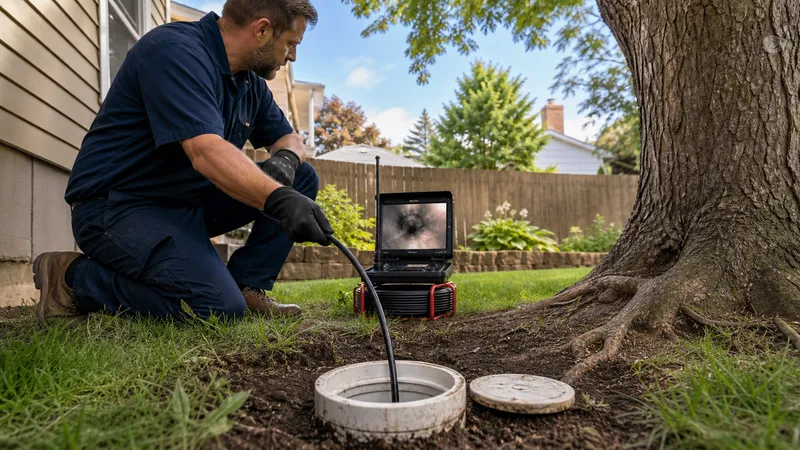
Yes, if the home is older, has mature trees near the line, or a history of clogs. A sewer scope runs a camera through the lateral—here's when it earns its cost.
Key takeaways
- Get one if the home is older than about 40 years, has mature trees within 20–30 feet of the line, or anyone mentions past clogs or backups.
- A sewer scope is a paid add-on, not part of a standard home inspection—InterNACHI and ASHI standards both exclude it from the base scope of work.
- It typically runs $150–$500 as a standalone service; a missing cleanout or hard-to-reach access point pushes that higher.
- It finds root intrusion, bellied (sagging) sections, offset joints, cracks, and full collapses—not leaks in supply lines or issues inside walls.
- Cast iron and clay pipe, common before the 1980s, are the two materials most likely to need this extra look before you buy.
- A scope only shows the day it was run. It doesn't predict a pipe that's fine today but fails in five years.
A sewer scope inspection is worth the extra cost for most homes older than about 40 years, any home with mature trees within 20–30 feet of the sewer line, and any home where the seller or a prior inspection report mentions clogs, slow drains, or a sewage backup. For a newer home on PVC pipe with a clean plumbing history, it’s a lower-priority add-on rather than a must-do. A sewer scope threads a video camera through the sewer lateral—the pipe running from the house to the city sewer main or septic tank—to find cracks, root intrusion, sagging sections, and collapses that a standard walk-through inspection cannot see, because that pipe runs underground and out of sight for its entire length.
This page covers what the scope actually is, when it earns its cost, what it can and can’t catch, and how to read a findings report. It doesn’t own the full home-inspection cost breakdown or the general red-flags list—those live in the broader Cluster G buying guides.
When a sewer scope is worth the extra cost
| Situation | Why it raises the risk | Get the scope? |
|---|---|---|
| Home built before ~1980s | Likely cast iron or clay lateral—both degrade with age and are prone to cracking or root entry | Yes |
| Mature trees within 20–30 feet of the line’s path | Roots seek out moisture and can enter through small cracks or joints, widening them over time | Yes |
| Seller mentions past clogs, slow drains, or a sewage backup | A history of drain problems often points to a partial blockage or damaged section, not a one-time fluke | Yes |
| Home has a septic system | The scope can check the lateral running to the tank, but the tank and drain field need a separate septic inspection | Yes, plus septic-specific check |
| Newer home (built after PVC became standard) with no reported drain issues | PVC resists root intrusion and corrosion far better than cast iron or clay | Optional |
| Condo or unit with no private lateral | Sewer line from the unit to the building main is often shared or building-owned | Usually not applicable |
Property owners are generally responsible for maintaining their own sewer lateral, including the section that runs under the yard to the property line—EPA case studies on lateral assistance programs confirm this is a common private-owner responsibility, which is exactly why a hidden defect in that pipe becomes the new owner’s problem, not the seller’s, once the sale closes.
What a sewer scope inspection can and can’t catch
| Can catch | Can’t catch |
|---|---|
| Root intrusion at joints and cracks | Supply (fresh water) line problems |
| Bellied or sagging sections that hold standing water | Plumbing inside walls or under slabs beyond the lateral |
| Offset or separated joints | A septic tank’s internal condition (needs its own inspection) |
| Cracks, fractures, and full pipe collapse | Defects hidden behind standing water or heavy debris in the pipe |
| Pipe material and general condition (cast iron, clay, PVC, ABS) | Future failure of a pipe that looks sound on inspection day |
| Blockages, grease buildup, and foreign objects | Anything beyond the camera’s cable reach or past a collapsed section |
A scope is a snapshot, not a warranty. It reports what the camera saw on the day it ran—not a prediction of what the pipe will do in five years.
How to read the findings
The report you get back should name specific defects, usually with a distance-from-access-point marker so a plumber knows where to dig or line if repair is needed. The common terms:
| Finding | What it means | General urgency |
|---|---|---|
| Root intrusion | Roots growing in through a joint or crack, sometimes forming a dense mass that catches debris | Address before it fully blocks the line; cutting roots is temporary, not a repair |
| Bellied pipe (a “belly”) | A low spot, usually from ground settling, where the pipe no longer slopes evenly and water pools instead of draining | Monitor if minor; a deep belly that holds standing water and collects solids is a repair candidate |
| Offset joint | Two pipe sections no longer aligned, leaving a lip or gap at the joint | Watch for worsening drainage; often paired with early-stage root entry at the gap |
| Cracked or fractured pipe | A visible break in the pipe wall, not yet fully separated | Repair timeline depends on severity and location; a cracked joint under a driveway costs more to reach |
| Collapsed section | The pipe has caved in and blocked or nearly blocked the flow | Needs repair before closing or as a negotiated repair credit—this is not a wait-and-see item |
Typical cost
A standalone sewer scope inspection typically runs $150–$500, according to Angi’s cost data, with the low end covering an easy cleanout access and the high end covering longer laterals or harder access. If the home has no accessible cleanout, installing one before the camera can go in adds $500–$1,500 on top of the inspection fee. This is the sewer-specific slice of the number—if you want the full home-inspection cost picture, that breakdown lives in the dedicated inspection-cost guide for this cluster.
When to call a professional
| Situation | Why it’s not DIY |
|---|---|
| You want a sewer scope done at all | Requires a specialized push camera, distance-tracking equipment, and someone who can read the footage correctly—this isn’t a rental-camera weekend project |
| The report shows a collapsed section or heavy root mass | Needs a licensed plumber to scope repair options: spot repair, trenchless lining, or full replacement |
| No accessible cleanout exists | Installing one, or removing a toilet for camera access, is plumbing work, not something to improvise |
| Recurring backups before you’ve had a scope done | Snaking the symptom repeatedly without diagnosing the cause risks a bigger failure later |
| Home has a septic system and the scope raises questions near the tank | Septic tanks and drain fields need their own licensed inspection—a sewer scope doesn’t substitute for it |
Related guides
Frequently asked questions
What is a sewer scope inspection?
It’s a video camera run through the sewer lateral—the pipe connecting the house to the municipal sewer main or septic tank—to find visible defects like cracks, root intrusion, bellied sections, and collapsed pipe. It’s a paid add-on service, not part of a standard home inspection.
Is a sewer scope inspection worth it when buying a house?
It’s worth it for homes older than about 40 years, homes with mature trees near the sewer line, homes with cast iron or clay pipe, or any home where the seller mentions a history of clogs or slow drains. For a newer home on PVC pipe with no red flags, it’s a lower-priority add-on.
How much does a sewer scope inspection cost?
Typically $150–$500 as a standalone service, according to industry cost data. If there’s no accessible cleanout, adding one before the scope can add $500–$1,500, since a technician needs an access point to feed the camera in.
What can a sewer scope inspection miss?
It only shows what the camera can see on the day it runs: standing water, dark pipe, or debris can hide a defect just past that point. It doesn’t inspect supply (fresh water) lines, plumbing inside walls, or the septic tank itself, and it can’t predict a pipe that looks fine today but fails later.
What does root intrusion in a sewer line look like on camera?
Fine root hairs or thick root masses growing in through a cracked pipe or a loose joint, usually clustered where two pipe sections meet. Left alone, roots widen the crack, slow the flow, and eventually block the line—cutting them out is a temporary fix, not a repair to the pipe itself.