
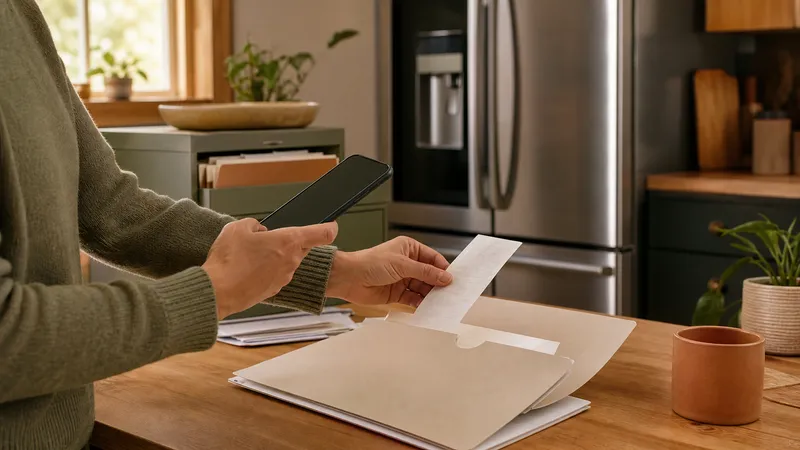
Save appliance receipts for warranty claims, insurance claims after a loss, and home-office tax basis—plus how long to keep them and stopping thermal fading.
Key takeaways
- Save the itemized receipt, not just a credit card charge—it shows the item, date, and price a warranty claim or insurance claim actually asks for.
- Photograph or scan thermal paper receipts within a few months of purchase; the ink fades and can go blank within a year or two even stored flat in a drawer.
- Keep an appliance receipt at least as long as its warranty, longer if it's in a home office or rental: the IRS says to keep property records until the period of limitations expires for the year you dispose of the property.
- FTC guidance: the receipt is what proves your purchase date and that you're the original owner—most manufacturer warranties run from that date, not from when you register the product.
- Insurers want proof of purchase and value after a theft, fire, or storm loss; store a backup copy off the property, not only in the house with the appliance.
- A photo backed up to the cloud, an emailed copy to yourself, or an app that stores the image all outlast a fading paper original.
Save appliance receipts because three different processes ask for them: a manufacturer’s warranty claim, a homeowner’s insurance claim after theft or loss, and—if the appliance is in a home office or rental—your tax return’s cost basis. Each one wants proof of what you paid, when, and for what, and the fastest way to lose that proof is to leave it on thermal paper in a kitchen drawer, where the ink itself fades within a year or two.
Why proof of purchase actually matters
| Process | What it needs from your receipt | Source |
|---|---|---|
| Manufacturer warranty claim | Purchase date and proof you’re the original owner | FTC Consumer Advice: Warranties—“Save your receipt… it’s your proof of the purchase date” |
| Homeowners insurance claim after theft, fire, or storm loss | Proof of ownership and the item’s value | NAIC: Filing a Homeowners Claim |
| Home-office or rental tax return | Cost basis for the appliance or improvement | IRS: How long should I keep records |
| Resale of the house or appliance | Documented value and upgrade history for a buyer or appraiser | Rule of thumb—not a legal requirement, but buyers and agents ask |
Miss the receipt and each of these gets harder, not impossible. A warranty department may accept a serial-number lookup instead; an insurer may accept photos and a replacement-cost estimate; the IRS may accept a bank statement. But every one of those workarounds is slower and less certain than the itemized receipt you already had at checkout.
What counts as valid proof of purchase
Not every record of a purchase carries the same weight. An itemized receipt is the strongest because it shows the specific item, model, price, and date in one document—exactly what a claims adjuster or warranty rep is trained to look for.
| Document | What it proves | Where it falls short |
|---|---|---|
| Itemized store or online receipt | Item, price, date, and retailer in one place | Paper thermal versions fade; needs to be photographed or downloaded |
| Credit card or bank statement | That a charge happened, on a specific date, at a specific merchant | Doesn’t show which item you bought if the same trip included other purchases |
| Store loyalty or online account history | Item-level purchase history tied to your account, often searchable years later | Only works if you used the account at checkout; some retailers purge history after a few years |
| Manufacturer’s registration confirmation | Model and serial number tied to your name | Confirms you registered the product, not that you’re the original purchaser or the price paid |
If you still have the physical receipt, an itemized one is worth digitizing first. If you’ve lost it, a credit card statement plus the retailer’s account history is usually enough to reconstruct the purchase for a claim.
The thermal paper problem
Most store receipts today print on thermal paper, not ink on regular paper—the black text is heat-sensitive dye, not toner. That dye continues to react to heat, light, and the plasticizers in some wallets and folders long after you leave the store, and a receipt kept flat in a drawer can still go partly or fully blank within a year or two. This is a homeowner observation, not a manufacturer or agency claim, but it’s the reason a “receipts drawer” quietly stops working as a record even when nothing was ever thrown away.
The fix is to stop relying on the paper at all once you’ve captured it:
- Photograph it the same week you buy the appliance, with the phone held flat and both edges of the receipt in frame.
- Scan it if you have a scanner or an all-in-one printer, which produces a sharper, more legible copy than most phone photos of small thermal text.
- Back the image up off the paper original—a cloud photo library, an email to yourself with the receipt attached, or an app that stores the image alongside the appliance record all survive the paper fading, being tossed in a move, or going through a wash cycle in a pocket.
How long to keep appliance receipts
| Purpose | Keep it for | Why |
|---|---|---|
| Manufacturer warranty claim | The full warranty period (often 1 year for parts, longer for sealed components like compressors or tanks) | You can’t claim after coverage ends regardless of what caused the failure |
| Homeowners insurance claim | As long as you own the item, ideally for higher-value appliances even after any warranty expires | Insurers ask for proof of value at time of loss, not just at time of purchase |
| Home-office or rental tax basis | As long as you own the property, plus the period of limitations after you dispose of it | IRS guidance: retain property records “until the period of limitations expires for the year in which you dispose of the property” (IRS: How long should I keep records) |
| General tax return support (non-property) | At least 3 years after filing | IRS baseline retention period for most individual return records |
The IRS applies the same logic to home improvements more broadly: Publication 523, Selling Your Home explains that records of improvements affect your home’s cost basis when you sell, which is a separate, longer-running reason to keep receipts beyond a single appliance’s warranty window—especially for built-in appliances that count as part of the house rather than a standalone purchase.
When to get help
| Situation | Why it’s not a DIY records fix |
|---|---|
| Manufacturer disputes your proof of purchase | Contact the retailer for a duplicate receipt or pull up your account/loyalty history before escalating the warranty claim |
| An insurance claim is denied for lack of documentation | Ask the adjuster in writing what proof would satisfy the claim, and provide bank statements, photos, or store account history as backup |
| You’re unsure whether an appliance qualifies for home-office or rental cost basis | Ask a tax preparer—basis rules differ for a home office deduction versus a fully separate rental unit |
| Every receipt for an appliance is gone and the warranty department won’t verify by serial number | Check the manufacturer’s registration records if you ever registered the product, or ask the original retailer to pull the sale from their system |
Related guides
Frequently asked questions
Do I need the original paper receipt, or does a credit card statement work?
A credit card or bank statement can back up a purchase date, but it usually won’t show the item, model, or exact price the way an itemized receipt does. Manufacturers and insurers generally want the itemized receipt first and treat a card statement as a fallback when the original is lost.
How long should I keep appliance receipts?
Keep a receipt at least as long as the appliance’s warranty period. If the appliance is in a home office or a rental property, keep it longer—the IRS recommends keeping property records until the period of limitations expires for the year you dispose of the property, which in practice means as long as you own it plus a few years after.
What if my thermal paper receipt has already faded?
Check your email for an order confirmation or digital receipt, look up the purchase on your credit card or bank statement, or check the retailer’s account history if you used a loyalty account or online order. Some manufacturers will also verify a warranty by serial number and an approximate purchase date if the retailer’s records go back far enough.
Do I need to keep receipts for appliances in a home office or rental property?
Yes. If you deduct a home office or report rental income, the IRS expects you to substantiate the cost basis of equipment and improvements with receipts, invoices, or cancelled checks. Keep those records for as long as you own the property, not just for the appliance’s warranty period.
Where should I store appliance receipts so I don’t lose them?
Keep a digital copy—a photo or scan—backed up somewhere other than the house itself: a cloud folder, an email to yourself, or an app. That protects the record from the same fire, flood, or move that could damage a paper original, and it survives long after thermal ink fades.