
What to check in a new home during your first week: utilities working, no leaks, safety devices present—a room-by-room move-in walkthrough.
Key takeaways
- This first-week check is about function and safety—utilities on, no leaks, alarms working—not a general inspection or a to-do list.
- Do the utility and safety-device check before you fully unpack; problems are easier to fix in an empty room.
- Test every smoke and CO alarm and confirm the manufacture date on each one; the USFA recommends 10-year replacement.
- Run every faucet, flush every toilet, and look under every sink for active or slow leaks in the first 48 hours.
- A full pre-purchase inspection already happened before closing—this is a different job: confirming what's actually working now that you live there.
What to check in a new home during your first week comes down to three questions: are the utilities actually working, is anything leaking, and are the safety devices present and functional? This is a first-week walkthrough, not a general inspection—do it before you’re fully unpacked, while an empty room still makes problems easy to spot.
The first-week walkthrough at a glance
| Area | What to check | Red flag |
|---|---|---|
| Utilities | Water, gas, electric, and HVAC all on and responding | Any utility that won’t turn on or hold |
| Safety devices | Smoke and CO alarms present, tested, and within their service life | Missing alarms or a manufacture date over 10 years old |
| Plumbing | Every faucet, toilet, and visible supply line | Drips, slow drains, or staining under sinks |
| HVAC | Thermostat responds, filter is present and reasonably clean | System won’t hold a set temperature |
| Electrical | Outlets and GFCIs work; panel is accessible | Warm outlets, tripped breakers that won’t reset, burning smell |
| Exterior | Doors and windows close and lock, grading slopes away from the foundation | Water pooling at the foundation, doors that won’t latch |
Utilities: confirm before you unpack
Test every utility the same day you get keys. Run water at every fixture, confirm the water heater produces hot water, check that the HVAC responds when you adjust the thermostat, and flip breakers to confirm power reaches every room. If anything was supposed to transfer into your name before move-in and didn’t, that’s a same-day call to the utility provider, not a wait-and-see item—see transferring utilities to a new home for the transfer process itself.
Safety devices: test and check the dates
Press the test button on every smoke alarm and every carbon monoxide alarm in the house. The USFA recommends testing monthly and replacing the entire smoke alarm every 10 years from its manufacture date—check the date printed on the back of each unit while you’re there, since sellers don’t always disclose alarm age. Carbon monoxide alarms have a shorter typical service life, often 5–7 years per manufacturer instructions, so check those dates separately.
Plumbing: the slow-leak walk
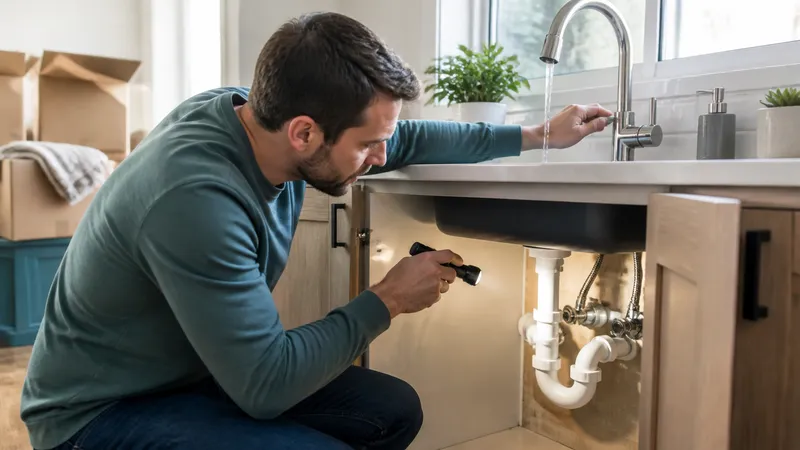
Run every faucet for about a minute and watch the supply lines and shutoff valves underneath. Flush every toilet and check its base and shutoff. Check under the kitchen sink, bathroom sinks, the washing machine hose connections, and around the water heater for staining, dampness, or a musty smell—these are the spots where a slow leak hides for months before it’s visible on a ceiling or floor.
HVAC and electrical: function, not deep diagnostics
Confirm the thermostat changes the system’s behavior within a few minutes and check the filter’s condition and printed size—you’ll need that size again for the month-by-month maintenance calendar. On the electrical side, test outlets in a few rooms and every GFCI (kitchen, bathrooms, garage, exterior) by pressing “test” and confirming it trips and resets.
When to call a professional
| Situation | Why it’s not a first-week DIY fix |
|---|---|
| Gas smell, active leak, or a CO alarm activation | Leave the house; call the gas utility or 911, not a general contractor |
| Electrical panel shows burning smell, warm switches, or breakers that won’t reset | A licensed electrician should inspect before you use that circuit |
| HVAC won’t hold temperature or the filter reveals a much larger duct issue | A licensed HVAC technician for diagnosis |
| Water heater is leaking or the pressure relief valve won’t reseat | A licensed plumber—these are pressurized systems |
Related guides
Frequently asked questions
What should I check first when I move into a new home?
Confirm all utilities are on and working—water, gas, electric, HVAC—and test every smoke and carbon monoxide alarm. These are the items with the shortest time window before a problem becomes expensive or dangerous, so they come before unpacking.
Is a first-week walkthrough the same as a home inspection?
No. A home inspection happens before you buy, is performed by a licensed inspector, and evaluates the home’s condition to inform your purchase decision. A first-week walkthrough happens after you own the home and simply confirms everything is working as expected now that utilities are live and you’re actually living there.
How do I check for leaks in a new home?
Run every faucet for a minute and watch the supply lines and shutoff valves underneath for drips. Flush every toilet and check its base and shutoff valve. Look at the ceiling below any upstairs bathroom, and check around the water heater and washing machine hoses for moisture or staining.
What safety devices should be present and tested in a new home?
Smoke alarms in every bedroom, outside each sleeping area, and on every level of the home; carbon monoxide alarms near sleeping areas if the home has fuel-burning appliances or an attached garage; and a working fire extinguisher in the kitchen. Test each device’s button and check the manufacture date.
What if something doesn’t work during the first-week check?
Note it immediately with a photo and date. If it’s a safety issue—no working alarms, an active leak, a utility that won’t turn on—address it before you finish moving in. If it’s a smaller issue, add it to your first-month punch list rather than letting it sit unaddressed.