
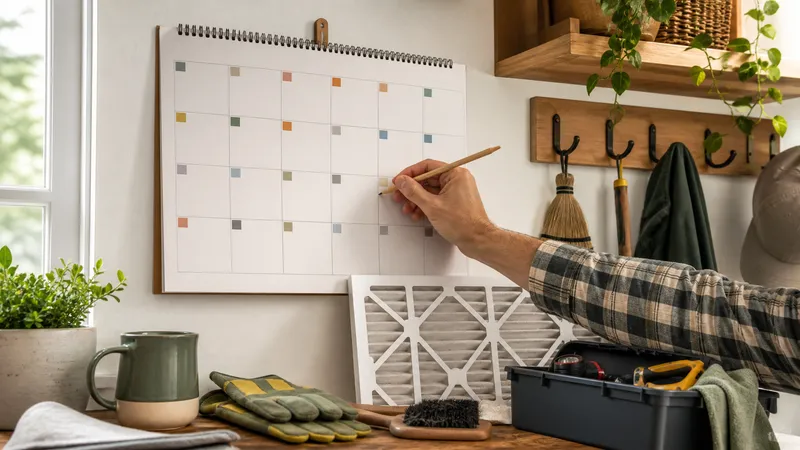
A month-by-month first-year homeowner maintenance calendar: HVAC filters, gutters, seasonal system checks, and what to schedule before each season changes.
Key takeaways
- Check your HVAC filter monthly and replace it every 1–3 months for a 1-inch filter—check monthly, replace sooner with pets or a smoker in the house.
- This is a repeating annual calendar, not a one-time onboarding sequence—see the first-30-60-90-days guide for the one-time version.
- Clean gutters twice a year at minimum: after leaves drop in fall and again in late spring, more often under heavy tree cover.
- Book HVAC service twice a year—cooling system in spring, heating system in fall—before the season that stresses it starts.
- Test smoke and CO alarms monthly year-round; that's the one task that doesn't wait for a season.
- Freeze-belt climates add pipe-freeze prevention in late fall; hot-humid climates add AC condensate-line checks in summer.
First-year homeowner maintenance follows a repeating monthly and seasonal rhythm: test safety devices every month, check HVAC filters every month, and layer in seasonal tasks—gutters, HVAC service, exterior checks—around the calendar. This page is that repeating calendar, built to run every year, not a one-time move-in list.
The month-by-month calendar
| Month | Focus | Key tasks |
|---|---|---|
| January | Winter safety | Test smoke/CO alarms, check attic for ice-dam signs, verify pipe insulation in unheated spaces |
| February | HVAC filter, indoor air | Replace filter if due, check for drafts around windows/doors |
| March | Pre-spring exterior | Inspect roof from the ground, check gutters for winter debris |
| April | Spring HVAC service | Book cooling system tune-up before hot weather, clean gutters |
| May | Exterior and irrigation | Check exterior caulk and weatherstripping, test sprinkler/irrigation if present |
| June | Cooling season checks | Replace HVAC filter, check AC condensate line for clogs |
| July | Mid-summer | Test smoke/CO alarms, check dryer vent airflow |
| August | Water heater | Flush water heater sediment per manufacturer guidance, check pressure relief valve |
| September | Pre-fall exterior | Clean gutters again, inspect roof and flashing before leaf season |
| October | Fall HVAC service | Book heating system tune-up before cold weather, replace filter |
| November | Freeze prep | Disconnect and drain outdoor hoses, insulate exposed pipes, test alarms |
| December | Winter safety recheck | Verify heating system is holding temperature, check for ice dams after first snow |
Monthly tasks that don’t wait for a season
Three tasks belong on every month’s list regardless of climate or season:
- Smoke and CO alarms. The USFA recommends testing every alarm monthly and replacing the entire unit every 10 years from its manufacture date. Carbon monoxide alarms typically have a shorter service life—many manufacturers set it at 5–7 years—so check the date on the back of each unit.
- HVAC filter. A 1-inch filter is typically good for 30–90 days; check it monthly and replace sooner if you have pets, allergies, or run the system heavily. A thicker 4-inch media filter often lasts longer—check the filter’s own printed interval.
- Quick leak walk. Look under sinks, around the water heater, and near any exposed supply lines. A slow leak caught in month two is a repair; the same leak caught in month eight can be a subfloor replacement.
Seasonal tasks and climate forks
| Season | Freeze-belt climates | Hot-humid climates |
|---|---|---|
| Spring | Check for winter pipe or roof damage first | Service AC early before peak cooling season |
| Summer | Standard filter and alarm cadence | Check AC condensate line and filter more often—every 30 days is common in heavy-use climates |
| Fall | Prioritize pipe insulation, disconnect hoses, and heating service before first freeze | Check HVAC for humidity control issues as usage shifts |
| Winter | Watch for ice dams, keep a trickle of heat in unheated areas with exposed pipes | Lighter seasonal burden—filter and alarm cadence continues |
When to call a professional
| Situation | Why it’s not a monthly DIY task |
|---|---|
| HVAC system won’t hold temperature or trips a breaker repeatedly | A licensed HVAC technician should diagnose electrical or refrigerant issues |
| Water heater shows rust, leaking, or a pressure relief valve that won’t reseat | A licensed plumber—these are pressurized, potentially scalding systems |
| Roof or gutter work above what you can reach from a stable ladder | A roofing contractor; falls are the most common home-maintenance injury |
| Dryer vent is long, concealed in a wall, or you can’t confirm it’s clear | A vent-cleaning service with proper equipment, per CPSC guidance on dryer fire risk |
Related guides
Frequently asked questions
What home maintenance tasks should be done every month?
Test smoke and carbon monoxide alarms, check (and replace if needed) the HVAC filter, run water in any unused drains to keep traps sealed, and do a quick visual walk for new leaks, stains, or pest signs. These are the tasks with the shortest consequence window if skipped.
How is a month-by-month maintenance calendar different from a 30/60/90 day plan?
A 30/60/90 day plan is a one-time onboarding sequence for the first three months in a new house—settling in, meeting the house’s quirks, finishing a punch list. A month-by-month calendar is the repeating annual rhythm you follow every year after that: the same filter change, the same gutter cleaning, the same seasonal HVAC service, on a loop.
Do I need professional HVAC service every year if the system is new?
Most manufacturers recommend annual service even on new equipment—it’s what keeps the warranty valid on many systems and catches small issues (refrigerant level, electrical connections, drainage) before they become a mid-season breakdown. Check your specific unit’s manual, since warranty service requirements vary by manufacturer.
What maintenance tasks are easy to forget in the first year?
Dryer vent cleaning, water heater sediment flushing, and exterior caulk/weatherstripping checks are the three most commonly skipped because nothing visibly breaks right away. By the time they cause a problem—reduced dryer airflow, a failing water heater, or a winter draft—it’s already cost you efficiency or money.
Should the maintenance calendar change based on climate?
Yes. Freeze-belt homes need pipe-freeze prevention and gutter-ice checks that hot-humid climates don’t, while hot-humid homes need more frequent AC filter and condensate-line attention than a mild coastal climate. Use this calendar as the base layer and adjust timing to your actual weather.