
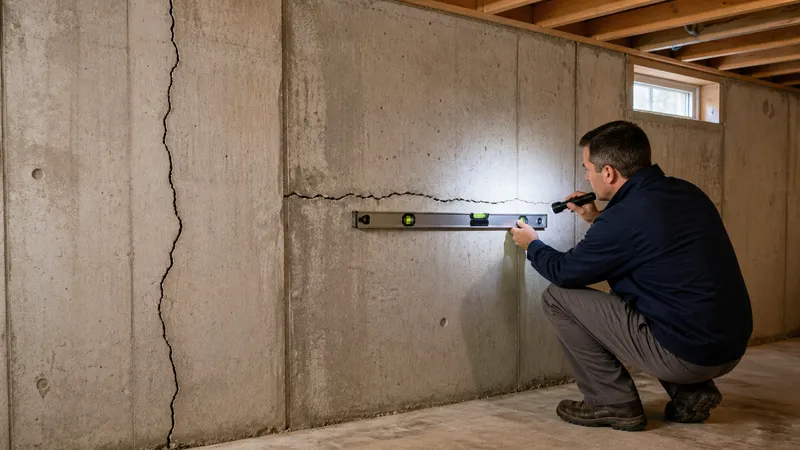
Crack orientation reveals the mechanism: vertical usually means shrinkage or settling, horizontal means lateral soil pressure. Here's how to tell them apart.
Key takeaways
- Vertical cracks usually form from concrete shrinkage or even settling—they run with the pour and are the least concerning orientation in most cases.
- Horizontal cracks form when soil pushes on the wall from outside (hydrostatic or expansive-clay pressure)—this is the pattern most likely to mean a bowing or failing wall.
- Horizontal cracking shows up mostly in concrete block (CMU) foundations, which have far less strength across a horizontal joint than solid poured concrete.
- Diagonal or stair-step cracks that follow mortar joints usually trace to differential settlement—one section of the footing sinking faster than the rest, often near a corner.
- A vertical crack with any horizontal offset, or bulging at the crack line, stops behaving like shrinkage—offset always outranks orientation.
- Horizontal cracks, bowing walls, and stair-step cracks with visible offset are structural-engineer calls, not waterproofing-company calls.
The direction a foundation crack runs tells you what’s pushing on the wall. A crack that runs straight up and down is almost always concrete shrinking as it cures or the wall settling evenly—the least concerning pattern. A crack that runs side to side is a different mechanism entirely: soil or water pressure pushing on the wall from outside, and it’s the orientation ASHI and structural engineers treat most seriously. A crack that zig-zags diagonally through the mortar joints of a block or brick wall points to a third cause: one section of the footing settling faster than another.
This page is the deep dive on why each orientation forms and what that mechanism means for repair. For the general question of whether any single crack is worth worrying about—width thresholds, growth monitoring, who to call—see foundation cracks: normal settling or a real problem?. If the crack is wet or the basement floods after rain, that’s a moisture and grading question first: see basement waterproofing and leak prevention.
Crack orientation at a glance
| Orientation | Likely cause | Typical severity | What to do |
|---|---|---|---|
| Vertical, hairline to narrow | Concrete shrinkage during curing, or even, minor settling | Low—usually cosmetic | Note it, recheck in a few months |
| Vertical, tapered or with offset | Uneven (differential) settling under one side of the wall | Moderate to high | Measure and monitor; get evaluated if it’s growing |
| Horizontal, at or below grade | Hydrostatic pressure, expansive clay, or frost pushing on the wall from outside | High—especially in block foundations | Call a structural engineer; check for wall bowing |
| Diagonal / stair-step through mortar joints | Differential settlement, often near a corner or footing weak spot | Moderate to high, depends on offset | Trace the settlement cause; get evaluated if offset is visible |
| Diagonal through brick veneer only (not the block/masonry behind it) | Veneer is decorative and unattached to the load-bearing wall—thermal movement or minor veneer settling | Usually low if the structural wall behind it is unaffected | Confirm the veneer hasn’t displaced out of plane; otherwise cosmetic |
Vertical cracks: why they form
A vertical crack runs roughly parallel to the wall’s vertical reinforcement or block coursing, straight up and down or with a slight lean. Two mechanisms produce most of them:
Shrinkage. Poured concrete keeps losing moisture and shrinking for months after the pour. Because the wall can’t shrink freely without cracking somewhere, cracks tend to open at the wall’s weakest or most restrained points—often near control joints, window openings, or the center of a long wall run. ASHI’s guidance on basement cracks notes these shrinkage cracks can reach roughly 1/8 inch wide on their own and are typically cosmetic.
Even settling. If the soil under the entire footing compresses at roughly the same rate, the wall can develop a vertical crack as it settles uniformly, without one side dropping relative to the other. That’s a different case from differential settling (below), because there’s no offset between the two faces of the crack.
The pattern that upgrades a vertical crack from “watch it” to “get it looked at”: it’s tapered—narrower at one end than the other—or it comes with a horizontal or shear offset, where you can feel one side of the crack sitting slightly higher, lower, or further out than the other. ASHI is direct about this: “vertical cracks with horizontal or shear movement at the crack always indicate a problem.” Offset means the two sides of the wall are no longer moving together, which points toward differential settlement even though the crack itself runs vertically.
Horizontal cracks: a different mechanism entirely
A horizontal crack runs side to side, often at or near a mortar joint partway up a below-grade wall. It is not caused by the wall’s own weight settling—it’s caused by something pushing on the wall from the outside face, and it’s the orientation that gets flagged fastest in a professional evaluation.
Three sources of that lateral push:
- Hydrostatic pressure. Soil saturated by rain or poor drainage exerts pressure against the outside of a foundation wall. The more saturated the soil and the poorer the grading and gutter drainage around the house, the more pressure the wall carries. (See the grading and downspout checks that reduce this load in the first place.)
- Expansive clay soil. Clay-heavy soils absorb water and swell, and that swelling generates substantial lateral force against a below-grade wall—not just the vertical heaving most homeowners associate with expansive soil. The Colorado Geological Survey documents expansive clay pressures reaching the tens of thousands of pounds per square foot in the worst cases, and notes the destructive force “may be vertical, horizontal, or both.”
- Frost. In cold climates, frozen, saturated soil against the wall adds to the same lateral load, which is why horizontal cracking and bowing often get worse or first become visible in late winter and early spring.
ASHI’s basement crack guidance gives a specific threshold worth remembering: “when the crack is over 1/8 inch wide and there is horizontal wall movement of 1/2 inch or more, the problem needs to be addressed.” That 1/2-inch figure refers to the wall actually bowing inward at the crack, measured with a straightedge or string line—not just the crack’s own width.
Why block foundations bow and crack horizontally more than poured walls
Horizontal cracking is disproportionately a concrete block (CMU) problem, and the reason is structural, not coincidental. A block wall is a stack of individual units held together by mortar joints, with much less tensile strength across those horizontal joints than a monolithic poured-concrete wall has across its full height. Older block foundations—especially ones built without vertical rebar and grouted cores—have little to resist lateral soil pressure once it exceeds the wall’s design capacity. Under sustained hydrostatic or expansive-soil pressure, the wall bows inward first, then cracks horizontally along a mortar course roughly a third to halfway up the wall, which is usually the point of maximum bending stress. Poured concrete walls face the same pressure but are more likely to resist longer before cracking, and when they do crack under lateral load it can show up as a vertical or diagonal pattern instead of a clean horizontal line.
Diagonal and stair-step cracks: differential settlement
A diagonal crack running through solid poured concrete, or a stair-step crack following the mortar joints in block or brick, points to a third mechanism: differential settlement—one section of the footing sinking faster than the section next to it. The wall was built as a rigid plane; it can’t flex to match uneven support underneath, so it fails along its weakest line. In a masonry wall, that weakest line is the mortar joint, which is why the crack “steps” diagonally from joint to joint instead of tearing straight through a block or brick.
Common causes of the uneven settlement itself:
- Soil that compresses, erodes, or was poorly compacted under only part of the footing
- A corner footing undermined by water erosion—often where a downspout has been discharging close to the foundation for years
- Fill soil under an addition or a section of the house that settles differently than the original, undisturbed soil elsewhere
Stair-step cracks that stay tight, don’t offset, and aren’t growing are common in older masonry foundations and often represent settlement that already happened and stopped. The distinguishing question is the same one that applies to vertical cracks: is there a visible offset where one side of the joint sits higher or further out than the other. Offset is the signal that pushes a stair-step crack from “monitor” to “get it evaluated,” not the zig-zag shape by itself.
One caveat worth separating out: a diagonal crack that appears only in a brick veneer, with no matching crack in the structural block or poured wall behind it, is a different and usually lower-stakes case. Veneer is a decorative facing, not load-bearing, and can crack from its own thermal movement or minor settling without the structural wall behind it being compromised. Confirm whether the crack continues into the structural wall before assuming the worst.
Related guides
Frequently asked questions
Why are horizontal cracks worse in concrete block foundations than in poured concrete?
A concrete block (CMU) wall is a stack of individual units joined by mortar, and unreinforced block has very little tensile strength across that horizontal joint line. When soil pressure pushes on the wall, block foundations tend to crack and bow along a mortar course partway up the wall, while a solid poured-concrete wall is more likely to resist longer or crack vertically instead. That’s why horizontal cracking is disproportionately a block-foundation problem.
Can a vertical crack ever be a structural problem?
Yes. Orientation is a starting signal, not a verdict. A vertical crack that’s tapered (wider at the top or bottom than the rest of its length), paired with a horizontal offset where one side sits proud of the other, or that keeps growing over months of monitoring is behaving like a settlement problem, not simple shrinkage. Width and displacement decide the case—see our guide to normal settling vs. a real foundation problem for those thresholds.
What causes stair-step cracks in brick or block foundations?
Stair-step cracks follow the path of least resistance through a masonry wall: the mortar joints, not the brick or block itself. They form when one section of the footing settles faster than the section next to it, often near a corner where a downspout has been dumping water and softening the soil. The wall can’t flex to match the uneven support, so it fails along the diagonal staircase of joints closest to the settling corner.
Does a horizontal crack always mean the wall is bowing?
Not always, but check for it. Hold a straightedge or level against the wall at the crack—any inward bow, even a slight one, means the lateral pressure has already deformed the wall, not just cracked it. A horizontal crack with no measurable bow yet is still a structural-engineer question; it just hasn’t reached the bowing stage.
Can frost cause a horizontal foundation crack?
Yes. Frost in saturated soil against a foundation wall adds to the same lateral pressure that causes hydrostatic cracking, and repeated freeze-thaw cycles can significantly increase the load on a wall over a single winter. It’s one more reason horizontal cracking often shows up or worsens in late winter and early spring rather than mid-summer.