
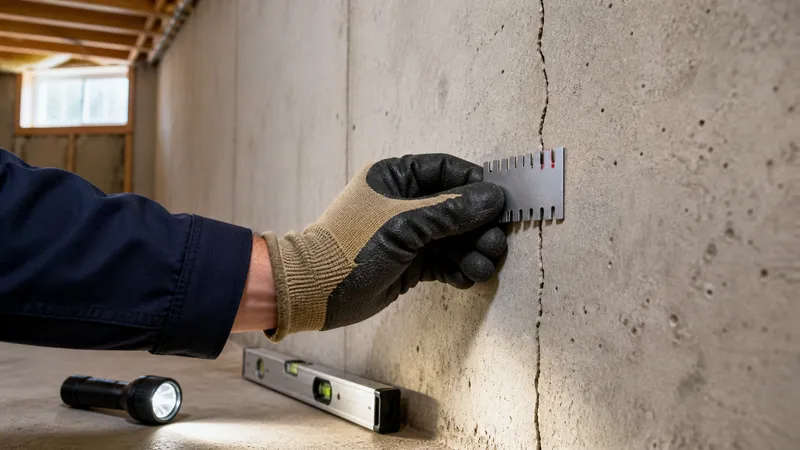
Most foundation cracks are hairline shrinkage, not structural failure. Here's the width, growth, and displacement thresholds that tell you which one you have.
Key takeaways
- A crack under 1/8 inch wide, with no offset between the two sides, is typically shrinkage—not a structural problem, per InterNACHI.
- A crack at or above 1/4 inch wide, or one where you can feel a step or ridge between the sides, warrants a professional look.
- New construction settles the most in the first 2-3 years; a wave of hairline cracks in that window is common, not automatically alarming.
- A crack alone rarely proves structural trouble—sticking doors, sloping floors, and gaps around trim in the same area are the corroborating signs.
- Call a structural engineer for a diagnosis, not a foundation repair company—a company that inspects and sells the repair has a built-in conflict of interest.
- Photograph every foundation crack with a ruler in frame and the date, and recheck it every few months for growth.
Most foundation cracks a homeowner finds are not a structural emergency. As a general rule of thumb used by home inspectors, a crack under 1/8 inch wide with no offset between the two sides is ordinary shrinkage or minor settling—cosmetic, not structural. A crack at or above 1/4 inch, or one where you can feel a step or ridge where one side sits higher than the other, is the point where InterNACHI and most inspectors say it’s time for a professional look. Between those two numbers is a gray zone worth watching, not panicking over.
This page covers the general question: is this crack something to worry about, and who do you call if it is. It doesn’t go deep on why a vertical crack behaves differently from a horizontal or stair-step one—see vertical vs. horizontal foundation cracks for that diagnosis. It also doesn’t cover basement water intrusion and grading, which is its own topic—see basement waterproofing and leak prevention if the crack is wet or the basement floods after rain.
Crack width: what’s normal and what isn’t
| Crack width | What it usually means | What to do |
|---|---|---|
| Hairline (under 1/16 inch) | Shrinkage as concrete cures, or drywall/plaster adjusting to minor framing movement | Note it, no action needed |
| 1/16 to 1/8 inch, no offset | Common minor settling, especially in homes under 2-3 years old | Watch it; recheck in a few months |
| 1/8 to 1/4 inch | Gray zone—could still be settling, could be early movement | Monitor closely; if it’s growing, get it looked at |
| 1/4 inch or wider | InterNACHI and most inspectors treat this as warranting professional evaluation | Call a structural engineer |
| Any width with a step or ridge (one side higher/further out than the other) | Displacement—more concerning than width alone, regardless of the measurement | Call a structural engineer |
These thresholds are common home-inspection rules of thumb, not a building code or a legal standard—your state or local code may set its own criteria for a real estate transaction. The American Society of Home Inspectors puts it plainly in its own basement crack guidance: hairline cracks from shrinkage “are not a concern since they are just cosmetic in nature,” while cracks that come with wall displacement, stacked horizontal cracking, or a bowing wall are the ones that call for a professional.
Why new homes crack too
Settling is not a sign the builder did something wrong. Poured concrete continues to lose moisture and shrink for months after the pour, and the soil under a new foundation keeps compacting under the building’s weight for the first couple of years as it adjusts. That’s why a wave of thin cracks in drywall corners, over door frames, or in the foundation itself is common in a house that’s 1-3 years old, and doesn’t by itself mean the foundation was built wrong.
What matters is whether that first round of cracking stops. A crack that appeared in year one and hasn’t changed since is doing what settling cracks do. A crack that’s still growing in year four, or that reopens after you patch it, is behaving differently than ordinary settlement and is worth a second look.
Crack type, briefly
Orientation matters, but only as a starting signal—width and displacement still decide whether it’s worth calling someone.
| Orientation | General concern level |
|---|---|
| Vertical | Usually the least concerning—often shrinkage or minor settling |
| Diagonal | Moderate—can indicate uneven settling under one section of the wall |
| Horizontal | Higher concern—can signal soil or water pressure pushing the wall inward |
| Stair-step (through block or brick joints) | Higher concern—typically settling or lateral pressure |
See vertical vs. horizontal foundation cracks for the full explanation of why each pattern forms and what it means for repair.
Other signs that point to a real structural problem
A crack rarely tells the whole story by itself. These are the corroborating signs inspectors look for in the same area of the house:
- Doors or windows that newly stick, bind, or won’t latch, especially if several in the same part of the house started at roughly the same time
- Floors that visibly slope, feel bouncy, or show a new dip when you set a level or a marble on them
- New gaps opening between baseboard trim and the floor, or between door/window trim and the wall
- Cracks that keep growing—mark both ends with a pencil and date, and recheck in 60-90 days
- A wall that’s visibly bowing or leaning inward, which can happen with or without a wide crack
One of these alone isn’t proof of a structural problem. A crack plus one or more of these in the same area is what should move you from “keep an eye on it” to “get it inspected.”
When to call a professional
| Situation | Why it is not DIY |
|---|---|
| Crack is 1/4 inch or wider | Past the threshold inspectors use for likely structural movement, not shrinkage |
| Crack shows a step, ridge, or offset between the two sides | Displacement is a stronger signal than width alone and needs a diagnosis |
| Crack is growing over weeks or months of monitoring | Active movement, not settled shrinkage—needs the cause identified |
| Crack appears with sticking doors/windows, sloping floors, or new trim gaps | Multiple signs together point toward structural movement, not a cosmetic issue |
| Wall is visibly bowing or leaning | Can indicate soil or hydrostatic pressure that needs an engineered fix, not a patch |
| You’re buying or selling and need a documented opinion | A stamped structural report is the standard a lender, insurer, or buyer’s attorney will expect |
Call a structural engineer for the diagnosis, not a foundation repair company. A repair company that offers a free inspection has an incentive to find a job—the same visit that diagnoses the problem is the one selling you the fix. A structural engineer who doesn’t perform repairs has no stake in whether you need work done, which is why an independent, stamped report is worth the fee before you sign a repair contract, especially for anything approaching the cost of a foundation job.
Related guides
Frequently asked questions
How wide does a foundation crack have to be before it’s a problem?
As a general rule, cracks under 1/8 inch with no vertical or horizontal offset are considered shrinkage and not structurally threatening, per InterNACHI’s guidance for home inspectors. Cracks at or above 1/4 inch, or any crack where one side sits higher or further out than the other, are worth a professional evaluation.
Is it normal for a new house to develop foundation cracks?
Some cracking in the first few years is common. Concrete continues to cure and shrink after it’s poured, and the soil under and around a new foundation keeps settling as it adjusts to the building’s weight. Most of this shows up as thin, stable hairline cracks, not the wide or displaced cracks that signal a structural issue.
What other signs mean a crack is a structural problem, not just cosmetic?
Doors or windows that suddenly stick or won’t latch, floors that visibly slope or feel bouncy, new gaps opening between trim and the wall or ceiling, and cracks that keep growing over a few months of monitoring. One crack alone rarely proves structural movement; a crack plus one or more of these signs is what should move you toward a professional inspection.
Should I call a structural engineer or a foundation repair company first?
Call a structural engineer for the initial diagnosis. A foundation repair company that offers a free inspection has an incentive to find a job to sell you; a structural engineer who doesn’t perform repairs has no stake in whether you need work done, which makes their assessment more reliable before you commit to a repair contract.
Are vertical cracks or horizontal cracks worse?
Vertical cracks are generally less concerning than horizontal ones, since they’re often just shrinkage or minor settling. Horizontal cracks can signal soil or water pressure pushing against the wall from outside, which is a more serious structural pattern. See our full breakdown of what each crack orientation means for the reasoning behind that difference.