
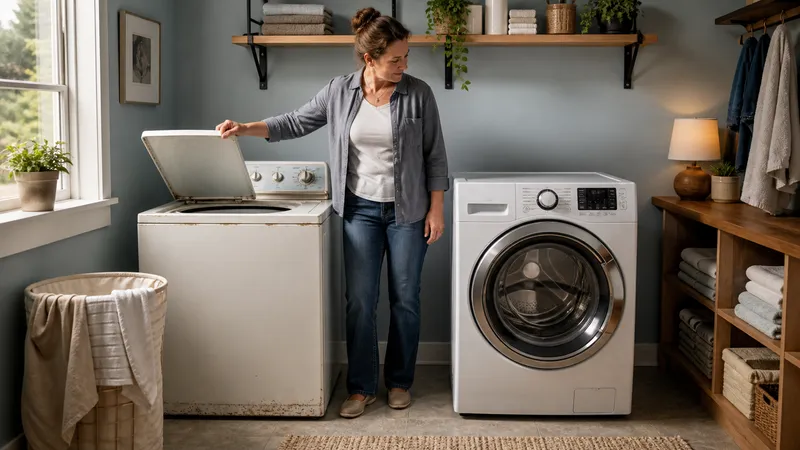
A washing machine typically lasts 8–12 years (InterNACHI: 5–15). See what shortens that, dying signs, and 2025 repair-vs-replace costs.
Key takeaways
- Typical washer lifespan is 8–12 years; InterNACHI's chart puts the full range at 5–15 years.
- Front-loaders have more moving parts (door lock, boot seal, bearing) that can fail before a top-loader's simpler drivetrain.
- A grinding or growling drum usually means a worn bearing—repair often runs $175–$225, close to half what a new washer costs.
- Control board repairs run roughly $250–$400 and motor repairs $300–$500 in 2025 estimates; compare that to a $450+ new machine before booking either.
- ENERGY STAR-certified washers use about 14 gallons per load versus 20 for a standard model—about 30% less water.
- An unlevel machine and a failed supply hose are the two most common causes of an early replacement, and both are preventable.
A washing machine typically lasts 8 to 12 years. InterNACHI’s life-expectancy chart, compiled from national appliance-industry data for home inspectors, lists a wider range of 5 to 15 years for washing machines—the spread mostly comes down to how often the machine runs and how well it’s been leveled, drained, and cleaned. A washer in a household of two running a few loads a week can clear 12–15 years; the same model doing two or three loads a day for a large family may need replacing well before 10. This page covers what actually shortens that life, the signs a machine is on its way out, and the repair-vs-replace math. For the recurring cleaning routine, see the washing machine maintenance guide; for the supply-hose replacement schedule, see the hose replacement guide.
Typical lifespan by machine type
| Machine type | Typical lifespan | What changes the number |
|---|---|---|
| Top-load washer (agitator or high-efficiency impeller) | 8–12 years (InterNACHI: 5–15 range) | Simpler drivetrain; fewer sealed components to fail |
| Front-load washer | 8–12 years, sometimes on the shorter end of the range | Door lock, boot seal, and drum-suspension bearing add failure points a top-loader doesn’t have |
| Heavy daily use (large household, 10+ loads/week) | Toward the low end (5–8 years) | More cycles wear the bearing, suspension, and motor faster |
| Light use (1–2 people, a few loads/week) | Toward the high end (12–15 years) | Fewer cycles, less mechanical wear per year |
Manufacturers don’t publish a single official lifespan figure for either configuration—InterNACHI’s chart lists one range for “washing machine” without splitting top-load from front-load. The practical difference is mechanical: a front-loader adds a door-locking mechanism and a rubber boot seal that a top-loader doesn’t have, and its drum spins on a different bearing and suspension arrangement to handle higher spin speeds. More parts that can fail is not the same as a shorter proven lifespan, but it does mean front-loaders often rack up more repair visits across the same number of years.
What actually shortens washer life
Three things account for most early failures, and all three are preventable:
- Running unlevel or overloaded. Every spin cycle on an unlevel machine, or one carrying an unbalanced load, works the suspension springs and drum bearing harder than a level, balanced machine ever would. Years of that strain wear the bearing out early and can crack suspension mounts. The maintenance guide’s leveling section covers how to check and fix this in a few minutes.
- A failed supply hose. A burst or slow-leaking hose doesn’t just soak the floor—water running into the base of the machine can reach the motor, control board, or bearing housing and damage the washer itself, not only the room around it. The hose replacement guide covers the 3–5 year swap interval and how to spot a hose that’s about to go.
- Skipping the drum-cleaning cycle. Detergent film, hard-water minerals, and trapped moisture that a monthly clean cycle would flush out instead sit against the door gasket and internal seals. Over years, that buildup degrades rubber seals and gaskets faster than clean water would, which is part of why a gasket that looked fine at year 3 needs replacing by year 7.
Signs a washing machine is dying
| Sign | What it usually means |
|---|---|
| Vibration or walking even when level and balanced | Worn suspension springs, shock absorbers, or drum bearing—not a settings problem anymore |
| Grinding or growling from the drum, especially during spin | A failing drum bearing—often a repair-vs-replace decision, not a quick fix |
| Water not draining fully after a cycle | Could be a clogged filter or a failing drain pump; persistent failure after cleaning the filter points to the pump |
| The same error code returns right after a reset | The underlying fault (often a sensor, pump, or control board) hasn’t actually cleared |
| Moldy smell that persists despite cleaning and an open door | Gasket or seal has degraded enough to hold moisture no amount of wiping reaches |
Repair-vs-replace: 2025 cost ranges
When a repair estimate comes in, compare it against a new washer’s price before approving the work. Fixr’s 2025 washing machine repair cost guide puts typical component costs at:
| Component | Typical 2025 repair cost | Repair-vs-replace note |
|---|---|---|
| Drum bearing | $175–$225 | Often close to half the price of a new $450+ washer, and the labor to reach it is extensive—many homeowners replace instead |
| Control board | $250–$400 | Worth repairing on a machine under ~5 years old; less so on an older unit already showing other wear |
| Motor | $300–$500 | Compare against total replacement cost—on a mid-range washer this can exceed half the price of new |
| Transmission | $200–$350 | Less common on modern direct-drive washers, more relevant on older belt-driven models |
Fixr frames the general rule of thumb as: if the repair costs more than about half of what a comparable new washer costs, replacement is usually the better value—especially once the machine is already past 8–10 years and other parts are wearing at the same rate.
A quick efficiency note
An aging top-load washer can be a bigger water bill than it looks like. ENERGY STAR-certified full-size washers use about 14 gallons of water per load, compared to 20 gallons for a standard machine—roughly 30% less per load (ENERGY STAR). ENERGY STAR also estimates certified models save about $530 in energy costs over the product’s lifetime versus a non-certified washer. If a machine is already showing wear signs from the table above, that water and energy gap is one more number to weigh against a repair bill.
When to call a professional
| Situation | Why it is not DIY |
|---|---|
| Grinding/growling bearing noise on a machine you plan to keep | Bearing replacement means disassembling the tub—specialized labor, not a home fix |
| Control board fault codes that persist after a reset | Board diagnosis requires model-specific test procedures a technician has, not guesswork |
| Active leak near an outlet, power strip, or the electrical panel | Water and live current together are a shock risk—unplug and call, don’t troubleshoot live |
| Burning smell, tripped breaker, or the motor won’t stop | Electrical fault inside a sealed component—stop use immediately |
| Machine still vibrates hard with a small, balanced, level load | Suspension or bearing wear beyond a leveling fix—get a repair quote before assuming it’s done |
Related guides
Frequently asked questions
How long does a washing machine last?
Most washing machines last 8–12 years with normal use and basic maintenance. InterNACHI’s home inspection life-expectancy chart lists a wider range of 5–15 years, reflecting how much usage frequency, water quality, and upkeep affect the outcome.
Do front-load washers last as long as top-load washers?
Front-loaders have more components that can fail—a locking door mechanism, a rubber boot seal, and often a more complex suspension—so they can see more repairs over a comparable lifespan. Neither style has a large, well-documented lifespan gap in manufacturer data; usage frequency and maintenance matter more than the door orientation.
Is it worth repairing a washing machine with a bad bearing?
Often not. Drum bearing replacement typically costs $175–$225 in parts and labor, and it usually requires disassembling the tub—labor-intensive work that can approach half the price of a comparable new washer. On a machine already past 8–10 years, most homeowners come out ahead replacing it instead.
What are the signs a washing machine is dying?
Persistent vibration or walking even when the machine is level and balanced, a grinding or growling noise from the drum, water that won’t fully drain, error codes that return right after a reset, and a moldy smell that cleaning doesn’t fix are the main signs a washer is nearing the end of its service life.