
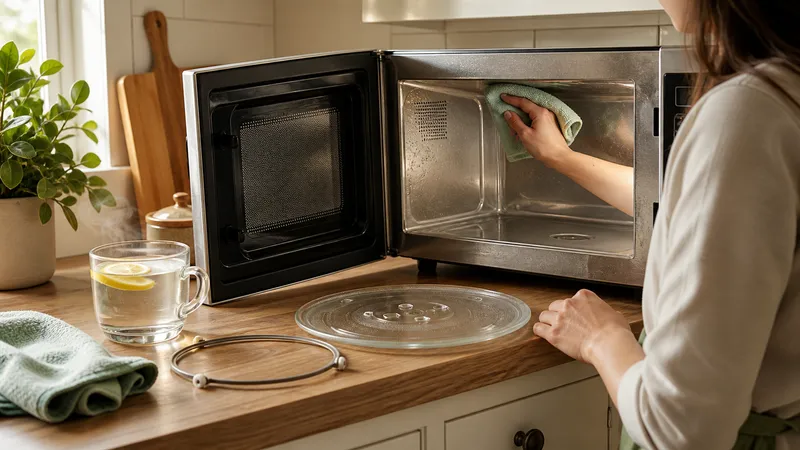
Microwave maintenance schedule: wipe the interior weekly, clean the turntable monthly, check the door seal, and know the real signs it needs service.
Key takeaways
- Wipe the interior weekly, or right after a spill—dried splatter can carbonize and cause arcing on some models.
- Wash the turntable and roller ring in warm soapy water monthly; run the oven only with both seated in place.
- A damaged door, hinge, latch, or seal is a stop-use issue per FDA, not a wipe-down—call the manufacturer or a technician.
- Over-the-range models: clean the metal grease filter monthly and replace a charcoal filter every 6–12 months.
- Never run the microwave empty or with metal inside—both send energy back into the magnetron and can damage it.
Microwave maintenance comes down to three cadences: wipe the interior weekly (or immediately after any spill), wash the turntable and roller ring in warm soapy water about monthly, and check the door seal every time you clean rather than waiting for a problem. Over-the-range models add a fourth job—cleaning the grease filter monthly. Skipping the interior wipe-downs lets food residue carbonize, which can cause arcing on some models; skipping the door-seal check misses the one microwave issue the FDA treats as a real radiation-safety concern, not a cosmetic one. This page covers the microwave hub cleaning routine end to end; see the appliance maintenance hub for other kitchen equipment.
Microwave cleaning schedule at a glance
| Task | Cadence | Method |
|---|---|---|
| Wipe interior walls, floor, and door window | Weekly, or right after a spill | Steam-loosen with a bowl of water and vinegar (below), then wipe with a damp cloth |
| Wash turntable and roller ring | Monthly, or when visibly soiled | Warm, soapy water by hand, or top-rack dishwasher if the manual allows |
| Check the door seal and hinges | Every cleaning | Look and feel for gaps, cracks, or a door that doesn’t sit flush; wipe the sealing surface with a mild, non-abrasive detergent |
| Clean the outside case and control panel | Weekly | Damp cloth; avoid ammonia or alcohol cleaners, which can dull the finish |
| Grease filter (over-the-range models only) | Monthly | Remove and wash the metal filter in hot, soapy water |
| Charcoal filter (recirculating over-the-range models only) | Every 6–12 months | Not washable—replace it |
Interior cleaning: the steam-a-bowl method
Dried splatter is harder on a microwave than it looks—besides being unpleasant to scrape off, GE’s owner’s manuals note that leftover food residue and grease is exactly what causes arcing (visible sparks) inside the cavity on some models. The easiest way to avoid a scraping fight:
- Microwave a bowl of water with a splash of white vinegar for 3–5 minutes, until it’s steaming well.
- Leave the door closed for another 5 minutes so the steam loosens splatter on the walls and ceiling.
- Wipe the interior with a damp cloth or sponge, using a sudsy cloth on greasy spots, then rinse with a clean damp cloth.
- Dry the interior—don’t leave standing moisture, especially around the door seal.
Avoid abrasive cleaners, scouring pads, or sharp utensils on the interior walls, and never use a commercial oven cleaner inside a microwave—it’s not designed for that finish. Do this weekly, and immediately after any boil-over or splatter, rather than letting it sit until the next scheduled clean.
Turntable and roller ring
The turntable and its support ring (sometimes called the roller ring or guide) usually lift out for cleaning. Wash them in warm, soapy water or on the top rack of the dishwasher if your manual permits it, and let the turntable cool before submerging it—cold water on a hot glass turntable can crack it. Put both back in place before the next use: microwave manuals are explicit that the oven should not be run without the turntable and its support seated correctly, since it’s part of how the appliance distributes microwave energy evenly.
Door seal, hinges, and the interlock system
This is the one microwave maintenance item the FDA treats as a genuine safety issue rather than a cleaning task. Microwave ovens are required to have two independent interlock systems that stop microwave production the instant the door latch releases or the door opens, plus a monitoring system that shuts the oven down if either interlock fails (FDA: Microwave Ovens). A federal standard (21 CFR 1030.10) limits leakage to 5 milliwatts per square centimeter, measured about 2 inches from the oven surface, for the life of the appliance—far below the level known to cause harm, and a level that drops off sharply with distance.
That standard depends on the door sealing correctly. The FDA is direct about what to do if it doesn’t: don’t use a microwave oven if you can’t shut the door, or if it doesn’t seal well, and contact the manufacturer if the door hinges, latches, or seal are damaged. Wipe the sealing surface—the area where the door meets the cabinet—with a mild, non-abrasive detergent each time you clean, and look for a door that closes flush, without light showing through or a gap you can feel.
Over-the-range models: grease filter and vent cleaning
An over-the-range (OTR) microwave doubles as your range hood, which adds a maintenance job a countertop model doesn’t have. GE’s OTR owner’s manuals describe two filter types:
| Filter | What it does | Cadence | Method |
|---|---|---|---|
| Reusable metal grease filter | Traps grease from cooktop cooking; also keeps flare-ups from a cooktop pan away from the oven’s interior | About once a month, or more with heavy use | Soak and swish in hot, soapy water; light brushing for embedded grime; skip ammonia, which darkens the metal |
| Charcoal filter (recirculating/ductless models only) | Removes smoke and odor when the vent isn’t ducted outside | Every 6–12 months, depending on use | Not washable—replace with the manufacturer’s part |
Leaving a grease filter dirty doesn’t just affect vent performance—the filter’s job is partly to keep cooktop flare-ups away from the microwave’s interior, so a saturated filter is doing that job poorly.
Never run it empty, never put metal inside
Both rules come down to the same physics: microwave energy that isn’t absorbed by food has to go somewhere, and that somewhere is back toward the magnetron, the component that generates the microwaves. GE’s owner’s manuals warn that operating the oven with no food inside for more than a minute or two “may cause damage to the oven and could start a fire,” since it increases heat around the magnetron and can shorten the appliance’s life. Metal causes the same reflection problem in a more visible way—arcing, or sparks—commonly from foil touching the cavity wall, twist-ties, metal trim on dishware, or metal flecks in recycled paper towels. If you see arcing, stop the oven and remove the metal before running it again; arcing that continues with no metal present is a sign to stop and have it serviced, not a food-prep workaround.
Signs of damage—and when to call a professional
| Sign | What it means | What to do |
|---|---|---|
| Door won’t close, latch is broken, or hinge is loose | The interlock system can’t confirm a sealed door | Stop use immediately; contact the manufacturer or an appliance repair technician |
| Visible sparking that continues with no metal inside | Possible damage to the interior coating, wave guide cover, or stirrer | Unplug and stop use; call a technician—don’t keep testing it |
| Persistent burning or electrical smell | Possible magnetron or wiring fault | Unplug at the wall, don’t run it again, and call a technician |
| Rust inside the cavity, especially near the door seal or vents | Rust can create arcing points and break down the shielded surface over time | Have a technician assess it; often a replace decision on an older unit |
| Light visible through the closed door, or a seal that doesn’t sit flush | A documented radiation-leakage path per FDA | Stop use and contact the manufacturer or a service center |
The internal high-voltage components—the magnetron and its capacitor—can hold a charge and deliver a serious shock even when the microwave is unplugged. That work belongs to a qualified technician, not a homeowner with a screwdriver. A visual check, a photo of the damage, and a service call are the correct next step, not a sign you failed to DIY it.
Related guides
Frequently asked questions
How often should I clean the inside of my microwave?
Wipe the interior weekly, and immediately after any spill or splatter. Dried, carbonized food residue can cause arcing on some models, so don’t let it build up between cleanings.
Is it dangerous to use a microwave with a damaged door seal?
Yes—stop using it. The FDA requires two independent interlock systems that cut microwave production the instant the door opens, and a damaged hinge, latch, or seal can prevent the door from sealing correctly, which is the agency’s documented radiation-leakage concern. Contact the manufacturer or a technician instead of continuing to use it.
Why can’t I run a microwave empty or put metal inside?
With no food to absorb the microwave energy, it reflects back toward the magnetron; GE’s owner’s manuals warn that running an oven empty for more than a minute or two can damage it and increases fire risk. Metal causes arcing—visible sparks—for the same reason: it reflects energy instead of absorbing it.
How often should I clean the grease filter on an over-the-range microwave?
GE’s over-the-range microwave manuals call for cleaning the reusable metal grease filter about once a month, or more often with heavy cooktop use, and replacing a disposable charcoal filter every 6 to 12 months depending on how much it’s used.