
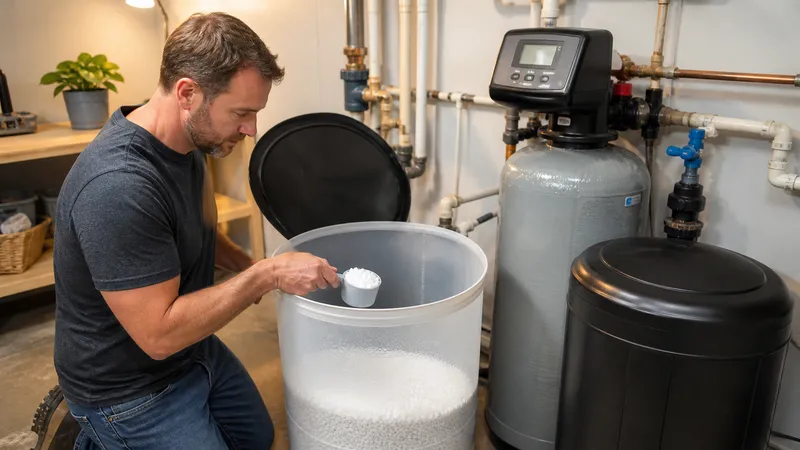
Salt-based water softener maintenance: refill salt before the tank runs empty, prevent salt bridging, and know when resin needs replacing.
Key takeaways
- Check brine tank salt monthly; most households refill every 2-4 months, keeping it 1/2 to 2/3 full, never to the brim.
- A hard crust above standing salt (a 'salt bridge') or a sludge layer at the bottom ('mushing') stops regeneration even though the tank looks full.
- Evaporated pellet salt causes the least bridging and residue; skip rock salt, which carries dirt that can foul the resin bed and valve.
- Clean the brine tank every few years, timed for when salt is low, to clear sediment and any mush before it hardens.
- Resin lasts roughly 10-15 years in good conditions but far less with heavy chlorine—soap that won't lather or stiff laundry means it's time to test, not just add salt.
- Resin bed replacement, a bridge you can't safely break, and control-head or wiring faults are professional jobs, not DIY fixes.
A salt-based water softener needs three recurring things to keep working: salt kept ahead of empty (check monthly, refill roughly every two to four months, never overfill), a brine tank that gets cleaned out every few years before sediment or a hardened salt mass builds up, and a resin bed that eventually wears out and needs replacing—typically after 10 to 15 years, sooner on heavily chlorinated water. Miss any one of the three and the symptom is the same: water goes hard again even though the machine is still running. This page covers the softener appliance itself—the brine tank, resin, salt, and control head, regardless of whether your water source is municipal or a private well.
The three-part maintenance schedule
| Task | Frequency | Why it matters |
|---|---|---|
| Check brine tank salt level | Monthly (until you learn your system’s pace) | Culligan recommends checking at least once a month as a baseline; running dry means the system “may not be able to soften and regenerate properly.” |
| Refill salt | Every 2-4 months, as needed | Culligan: refill frequency depends on water hardness, household water use, and system type and age. Keep the tank 1/2 to 2/3 full—Kinetico warns that filling it completely “could cause the salt to bridge.” |
| Break up salt bridges or mush | As soon as you spot one | A hardened crust (“bridging”) or a sludge layer (“mushing”) both prevent the brine solution from reaching the resin during regeneration, per Culligan. |
| Clean the brine tank | Every few years, timed for when salt is low | Culligan recommends periodic cleaning to clear sediment and maintain “peak operating efficiency.” |
| Check resin performance / add resin cleaner | Annually | Kinetico-affiliated guidance recommends a yearly dose of resin cleaner to keep hardness minerals and iron from building up on the beads. |
| Test water hardness | A few times a year, or when symptoms appear | Confirms the softener is still regenerating correctly between visible symptoms. |
| Full resin bed inspection/replacement | Once resin is 10-15 years old, or sooner with heavy chlorine or iron | Purolite, a resin manufacturer, states a premium cation resin gives “reliable operation for over ten years” under normal conditions, but oxidizers shorten that considerably. |
Salt: keeping it filled without overfilling
Running low on salt is the most common reason a softener “stops working” without any mechanical fault at all. When the brine tank runs dry, there isn’t enough concentrated brine to recharge the resin bed during regeneration, and the system starts passing hard water straight through.
Most households land on a refill rhythm of every two to four months, but that range moves with your water hardness, how many people are in the house, and whether the unit regenerates on a timer or on demand (more water use means more regenerations, which means more salt burned). Check monthly for the first few months you own the system to find your own pace, then set a reminder instead of guessing.
Don’t fill it to the top. Keeping the tank half to two-thirds full gives the salt room to dissolve properly and cuts the risk of the two failure modes below. A tank packed solid with salt, especially in humid conditions, is the classic setup for a salt bridge.
Salt bridging and “mushing”
These are the two real, common failure modes in a brine tank, and both can leave the tank looking full while the softener quietly stops regenerating:
- Salt bridging is a hardened crust that forms above the water line, usually from humidity, temperature swings, or an overfull tank. The crust holds itself up as an arch, leaving an empty air pocket underneath—so a glance at the tank shows salt near the top, but no salt is actually dissolving into brine. Culligan describes it as salt that “cakes or otherwise coagulates a large mass,” hiding empty space below.
- Mushing is the opposite problem: salt breaks down into a thick, sludge-like paste that settles at the bottom of the tank and can clog the tank’s outlet or the brine valve, per Culligan.
To clear a bridge: shut off the water supply to the softener or switch it to bypass, then use a broom handle, wooden dowel, or similar long tool to carefully break up the crust from the top down (a rubber mallet tapped against the outside of the tank can help loosen it too). Remove the loosened chunks, pour in warm water to dissolve the leftover residue, let it sit 45-60 minutes, then run a manual regeneration cycle to confirm the system recovers. If the crust is thick, hard to reach, or keeps reforming within weeks, that’s worth a service call rather than repeated tank-poking.
Salt type comparison
| Salt type | What it is | Bridging/residue risk | Recommendation |
|---|---|---|---|
| Evaporated pellet salt | Highest-purity sodium chloride, machine-formed pellets | Lowest—dissolves cleanly, least insoluble residue | Generally the top pick for most softeners |
| Solar salt | Sun-evaporated seawater or brine, sold as crystals or pellets | Moderate—less pure than evaporated salt but still low-residue | A solid second choice, often cheaper |
| Rock salt | Mined salt, minimally processed | Highest—carries dirt and mineral impurities | Avoid; Kinetico warns rock salt “can contain dirt or other debris that could clog or harm your water softener” |
| Potassium chloride | Sodium-free regenerant alternative | Low, but requires different system settings | Only with dealer/manual guidance on dosing changes |
How to tell the system needs service
If the brine tank has salt and the softener still isn’t softening, the problem has moved past “add more salt.” Watch for:
- Soap and shampoo won’t lather. Hard water reacts with soap to form a dull scum instead of foam—Culligan lists weak lathering as a direct hard-water symptom.
- Spots or a chalky film on dishes, even straight out of the dishwasher.
- Stiff, scratchy laundry that doesn’t feel fully rinsed.
- Limescale creeping back around faucets, showerheads, and the tub.
Run through the basics before assuming the resin has failed: confirm there’s actual salt (not a bridge or mush) in the tank, confirm the bypass valve is fully open to the softener rather than partway to bypass, and run a manual regeneration. If hardness symptoms persist after all three, the resin bed, the injector/venturi that draws brine, or the control head is the likely cause, and that’s a service visit.
Resin bed life and what shortens it
The resin bed is where the actual softening happens—hardness minerals swap onto resin beads during normal use, and brine flushes them off during regeneration. Purolite, a resin manufacturer, states a premium strong-acid cation resin can give “reliable operation for over ten years” in a well-designed system, and other manufacturer guidance puts the practical range at roughly 10-15 years.
Chlorine is the biggest thing that shortens resin life. Purolite’s technical guidance is specific: each additional 1 mg/L (1 ppm) of free chlorine in the incoming water can cut resin life by roughly half, and in warmer water, even modest chlorine levels can bring resin life down to under two years in the worst cases. Iron fouling compounds the damage. If your water supply is more heavily chlorinated than average municipal water, a whole-house carbon pre-filter ahead of the softener is the standard way to protect the resin and extend its working life.
Resin doesn’t announce its own failure the way a bridge or empty tank does—it shows up as the same hardness symptoms listed above, persisting after you’ve ruled out salt and settings. Diagnosing whether the resin itself (versus the valve, injector, or control board) is the cause usually needs a technician, since it involves opening the resin tank.
Basic regeneration-cycle checks
Most modern softeners regenerate automatically on a timer or on-demand based on water use, but a quick homeowner check confirms it’s actually happening:
| Check | What you’re looking for |
|---|---|
| Listen or watch for a regeneration cycle | The unit should cycle at its scheduled time (often overnight); water pressure or a faint valve noise from the control head confirms it ran |
| Salt usage after a cycle | Salt level should drop slightly after each regeneration—no drop at all over several expected cycles suggests brine isn’t being drawn |
| Bypass valve position | Confirm it’s fully seated toward “service,” not partway toward “bypass,” which sends untreated water past the softener entirely |
| Manual regeneration button | Use it to force a cycle and confirm the system responds and salt level drops afterward |
When to call a professional
| Situation | Why it is not DIY |
|---|---|
| Resin bed needs replacement | Requires opening the resin tank and correctly sizing/loading new resin for your model |
| A salt bridge or mush you can’t safely break up | Repeated force risks cracking the brine tank or damaging the riser tube |
| Electrical or control-head faults (no display, cycles won’t trigger, error codes) | Involves the unit’s wiring and electronics, not the brine tank |
| Any plumbing change to the bypass valve or main connections | Improper reassembly can leak or send hard water through unfiltered |
Related guides
Frequently asked questions
How often should I add salt to my water softener?
Check the brine tank monthly for the first few months to learn your system’s pace, then refill on that schedule—typically every two to four months depending on water hardness, household size, and how often the unit regenerates. Keep the tank about half to two-thirds full rather than topping it off completely.
What is salt bridging and how do I fix it?
A salt bridge is a hardened crust that forms above the water line in the brine tank, leaving an empty pocket underneath even though the tank looks full. Break it up carefully with a broom handle or similar long tool (system off or in bypass), remove the loosened chunks, and let warm water dissolve the residue before running a manual regeneration.
How long does water softener resin last?
A well-maintained resin bed on municipal water typically lasts 10 to 15 years. Chlorinated water shortens that significantly—resin manufacturers note that each additional 1 ppm of free chlorine in the feed water can cut resin life roughly in half, sometimes down to just a year or two in poorly filtered, heavily chlorinated supplies.
What salt should I use in a water softener?
Evaporated pellet salt is generally the best choice: it is high-purity, dissolves cleanly, and leaves the least residue and bridging risk. Solar salt (sodium chloride crystals from evaporated seawater) is a reasonable second choice. Rock salt is the least refined and least recommended—its dirt and mineral content can accumulate as sediment in the tank and stress the valve.
How do I know my water softener needs service, not just more salt?
Watch for hardness symptoms even with a full salt tank: soap and shampoo that won’t lather, spots or film on dishes coming out of the dishwasher, stiff or scratchy laundry, and scale building back up around faucets. If those show up right after a refill and a manual regeneration, the resin bed, injector, or control head—not the salt supply—is the likely cause.