
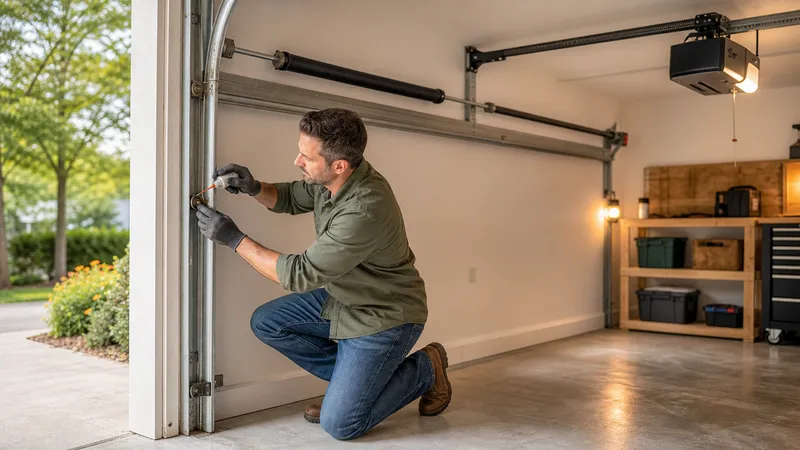
A monthly garage door maintenance routine: balance and auto-reverse safety tests, track and roller care, opener sensors, and why springs are never DIY.
Key takeaways
- Test the auto-reverse safety feature monthly: a 2x4 laid flat under the door should stop and reverse the door on contact, per CPSC guidance.
- Run a monthly balance test too—disconnect the opener and the door should hold its position when raised halfway. If it drifts, that's a spring problem.
- Lubricate rollers, hinges, and springs every 3-6 months with a silicone or white lithium garage-door lubricant, never WD-40 as a long-term lubricant.
- Clean and align the photo-eye sensors near the floor if the door reverses or won't close—misalignment is the most common no-close cause.
- Never touch a torsion spring. CPSC and NEISS data tie garage doors and openers to roughly 20,000-30,000 emergency-room visits a year in the US.
- Replace worn bottom weatherstripping yourself; leave cables, drums, and any spring adjustment to a licensed technician.
Garage door maintenance for most homeowners comes down to two monthly safety tests (balance and auto-reverse), a seasonal lubrication and cleaning pass on the rollers and track, and a hard rule: never touch the torsion spring. The Consumer Product Safety Commission urges owners to test the auto-reverse feature monthly and to have a professional service any door that is out of balance, binds, or sticks—springs and their hardware are called out specifically as a source of serious injury. This page covers the checks and cleaning a homeowner can safely do, and draws a clear line at the point where the job becomes a call to a licensed garage door technician.
Monthly garage door checks
These take about ten minutes and catch the failures that turn into a stuck door, a fall, or a call for emergency service.
| Task | Frequency | Why it matters |
|---|---|---|
| Auto-reverse safety test | Monthly | CPSC says to test the reversing feature monthly. Lay a 2x4 flat on the floor under the door’s path and close it—the door should stop and reverse within about two seconds of contact. If it doesn’t, stop using the opener until it’s serviced. |
| Balance test | Monthly | Pull the manual release cord to disconnect the opener, then lift the door about halfway by hand. A balanced door holds its position. One that falls or shoots up means the spring tension is off—a job for a technician, not a DIY adjustment. |
| Visual inspection of springs and cables | Monthly | Look, don’t touch. Gaps between coils, rust, or a frayed cable are signs the system is due for professional service before it fails under load. |
| Track alignment | Monthly | Sight down each track for gaps, dents, or a track pulling away from the wall. A misaligned track makes the door bind or jump off the rollers. |
| Photo-eye sensor check | Monthly | Confirm both sensor lights are solid and the lenses are clean. Misaligned or dirty sensors are the most common reason a door won’t close or reverses for no visible reason. |
| Hardware check | Monthly | Tighten visibly loose roller brackets, hinges, and track bolts with a wrench—vibration works these loose over time. |
If you only do two things from this list, do the auto-reverse test and the balance test. Both take under two minutes and both catch problems—an unbalanced door or a failed safety reversal—that can seriously hurt someone.
Lubrication: what to use and where
| Part | Lubricant | Frequency | Notes |
|---|---|---|---|
| Rollers (metal, not nylon) | Silicone-based garage-door spray | Every 3-6 months | Clopay recommends silicone because it resists attracting dirt across temperature swings. Nylon rollers should not be lubricated. |
| Hinges | Silicone spray or white lithium grease | Every 3-6 months | Heavy daily use (4+ cycles a day) points to the 3-month end of that range. |
| Torsion spring | White lithium grease | Every 3-6 months | Grease clings to the coil and protects against rust; this is inspection-and-lubrication only—never adjustment. |
| Lift cables at the bottom bracket | Light silicone spray | Every 3-6 months | Avoid soaking the cable where it wraps the drum. |
| Tracks | None | — | Clean with a damp cloth only. Lubricant on the track surface attracts grit and makes rollers stick, according to Clopay’s maintenance guidance. |
| Weatherstripping / bottom seal | None | — | Lubricant degrades rubber seals; clean with mild soap and water instead. |
Track alignment and cleaning
The vertical and horizontal tracks guide the rollers and keep the door traveling in a straight line. Twice a year, or whenever the door sounds rougher than usual:
- Wipe both tracks with a damp cloth to remove built-up dirt and old grease—do not apply lubricant here.
- Check for gaps between the track and the roller. A gap wider than about 1/8 inch, or a track that has visibly pulled away from its wall bracket, means the mounting bolts need tightening or the track needs realignment.
- Look for dents or bends, especially near the bottom section where a car bumper or a dropped tool is most likely to hit. A dented track can throw rollers off course.
- Confirm both tracks are level and parallel using a level held against each vertical section. An out-of-level track is a common cause of a door that binds partway through its travel.
Minor gaps and loose bolts are a reasonable DIY fix with a wrench. A track that’s visibly bent, pulled away from the framing, or forcing the door off its rollers is worth a technician visit—forcing a misaligned track back into place under spring tension is exactly the kind of job where things go wrong fast.
Weatherstripping and the bottom seal
The rubber seal along the bottom of the door keeps out water, drafts, and pests, and it wears out faster than almost anything else on the door because it touches the ground on every cycle.
- Check twice a year for cracking, flattening, or gaps where daylight shows through at the bottom corners.
- Replace it yourself. Bottom seals slide out of a retaining track and a new one slides back in—no tools beyond a utility knife in most cases, and no interaction with springs or cables.
- Measure the door width before ordering; residential doors commonly use a T-style or bulb-style seal sized to the door’s actual width, not a universal size.
Opener maintenance and the photo-eye sensors
Most “my garage door won’t close” calls trace back to the photo-eye sensors—the small units mounted a few inches off the floor on each side of the track that beam an invisible line across the doorway.
| Symptom | Likely cause | Homeowner fix |
|---|---|---|
| Door reverses partway down with nothing visible in the way | Sensor beam blocked, dirty, or misaligned | Wipe both lenses with a soft cloth; confirm both indicator lights glow solid, not blinking |
| Door won’t close at all, opener hums but nothing moves | Sensors out of alignment (aim shifted after a bump) | Loosen the wing-nut or bracket screw on one sensor and gently adjust until both lights turn solid, then retighten |
| Door closes fine at night, fails in direct sun | Sun glare on the receiving sensor | Add a small shade or angle the sensor slightly away from direct sunlight |
| Opener runs but door doesn’t move, or reverses immediately after opening | Travel limit or force setting drifted | Check the opener manual for the limit-adjustment screws or menu; if the door still binds mechanically, treat it as a track or spring issue first |
Photo-eye sensors are also required equipment under the federal entrapment-protection standard for openers sold since 1993—cleaning and aligning them is homeowner-safe, but do not defeat, unplug, or bypass them to “get the door working,” since that removes the exact protection they exist for.
When to call a professional
| Situation | Why it’s not DIY |
|---|---|
| Torsion spring adjustment, winding, or replacement | A wound spring stores enough force to seriously injure or kill; CPSC-linked injury data shows thousands of ER visits a year tied to garage doors and openers, with springs a recurring cause |
| Cable replacement or fraying lift cables | Cables carry the same tension as the spring system and can whip or snap under load |
| Any work on the torsion spring tube, drums, or bearing plates | This is one connected high-tension system—working on one part without the right tools affects the whole assembly |
| Door won’t balance even after visual inspection | Points to spring tension, which requires the winding bars and clamps a technician uses safely |
| Opener circuit board issues, erratic behavior, or repeated force-setting failures | Electrical and safety-logic troubleshooting on the control board, not a mechanical fix |
| Bent or torn panel sections, or a door that’s jumped the track | Reinstalling a door under spring tension without the right equipment risks a sudden drop |
Keep a record
| Keep this | Why |
|---|---|
| Date of last balance and auto-reverse test | Confirms the safety checks are actually happening monthly, not just planned |
| Photo of the spring coils and cables | Lets a technician compare wear over time without a second visit just to look |
| Door brand, model, and approximate install year | Springs and openers are typically rated by cycle count, which ties to age and daily use |
| Date of last professional service | Anchors when the spring system was last inspected by someone qualified to touch it |
Related guides
Frequently asked questions
How often should I test my garage door’s auto-reverse safety feature?
Every month. Place a 2x4 board flat on the ground, centered under the closed door’s path, and trigger the door to close. It should touch the board and reverse within about two seconds. If it doesn’t, or the door keeps pushing into the obstruction, stop using the opener until a technician resets the force settings.
What lubricant should I use on a garage door?
A silicone-based spray or white lithium grease made for garage doors, applied to rollers, hinges, and springs every 3 to 6 months. Avoid WD-40 for ongoing lubrication—it displaces water well but evaporates quickly and attracts dust rather than protecting parts long-term. Never lubricate the tracks themselves or nylon rollers.
Can I replace a garage door spring myself?
No. A wound torsion spring stores enough energy to lift a 200-400 pound door thousands of times, and it can release that energy in a fraction of a second if it slips off a winding bar or the wrong tool. CPSC injury data and industry safety groups treat spring adjustment and replacement as licensed-technician work, not a homeowner project.
Why won’t my garage door close all the way?
The most common cause is misaligned or dirty photo-eye sensors near the floor on each side of the track. Wipe the lenses and confirm both indicator lights are solid, then check that nothing—including a shadow from direct sun—is blocking the beam. If the sensors line up and the door still won’t close, the issue is more likely the travel limit or force setting, which is opener-specific and worth checking against the manual before calling for service.
How long do garage door springs and cables typically last?
Most torsion springs are rated for 10,000 to 20,000 open-close cycles, which works out to roughly 7 to 12 years for an average household using the door 3-4 times a day. Heavier doors, harsher climates, and multiple daily cycles shorten that range. A spring nearing the end of its cycle life is a scheduling problem to raise with a technician, not a wait-for-failure one.