
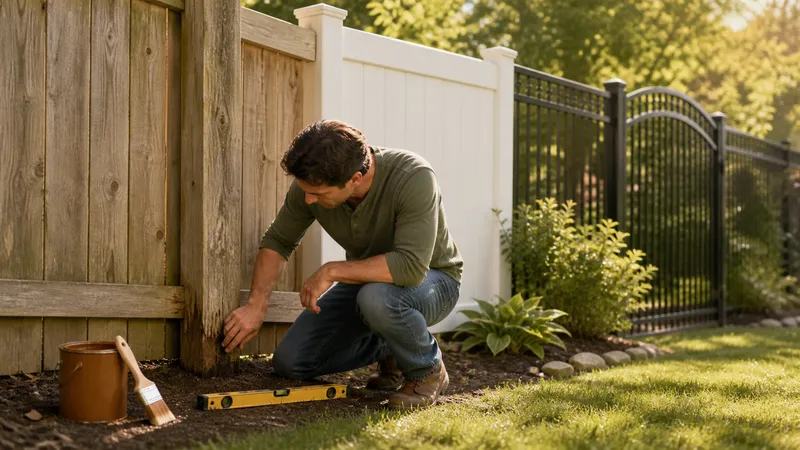
Fence maintenance splits by material: wood needs stain or seal every 1-3 years, vinyl just needs washing, and every fence lives or dies on its posts.
Key takeaways
- Wood fences: clean yearly and stain or seal every 1-3 years—closer to 1-2 years in full sun, up to 3 in shade.
- Vinyl fences: wash occasionally, never stain or seal. Chalking or fading over years is normal weathering, not damage.
- Chain-link and metal: check rust points and gate/tension hardware twice a year, spring and fall.
- Regardless of material, the most common fence failure is a rotted or heaved post base, not the panels or pickets.
- A leaning fence line—several posts, not one—usually means the footings failed, not the boards.
- A property-line dispute over a fence is a legal question for a survey and an attorney, not a maintenance task.
Fence maintenance splits by material, not by a single national rule. Wood fences need periodic cleaning and a fresh stain or sealer roughly every 1 to 3 years. Vinyl fences need occasional washing only—never stain, paint, or sealer—though cheaper vinyl can chalk or fade under years of direct sun. Chain-link and other metal fences need a rust-point check and occasional tension adjustment, typically twice a year. But underneath all three, there’s one check that matters for every fence regardless of material: post stability. The most common fence failure is a rotted or frost-heaved post base, not the panels, pickets, or fabric people usually worry about.
Fence maintenance by material
| Material | Cleaning frequency | Stain/seal frequency | Common failure point |
|---|---|---|---|
| Wood (pressure-treated, cedar, pine) | At least once a year; twice in shaded, high-pollen, or sprinkler-splash areas | Every 1-3 years—closer to 1-2 years in full sun or against sprinklers, up to 3 years if shaded, per stain manufacturers like Behr | Post base rot at or just below the soil line, where moisture sits longest |
| Vinyl / PVC | Once a year with soap and water; every 3-6 months under trees or near lawn clippings | Never—vinyl isn’t designed to accept stain or sealer | Post caps and rail connectors loosening; gradual UV chalking or fading over many years, which manufacturers call normal weathering |
| Chain-link / galvanized steel | Rinse or wipe down 2-3 times a year to keep the zinc coating clear of grit | Not applicable (bare or vinyl-coated wire doesn’t take stain); touch up rust spots with a rust-inhibiting metal paint as they appear | Rust at cut ends, welds, and ground contact points; sagging fabric from loosened tension wire |
| Aluminum / wrought iron | Rinse and wipe 1-2 times a year; more near salt air or sprinklers | Powder-coated aluminum doesn’t need repainting; bare wrought iron needs rust-inhibiting paint touch-ups as needed | Rust at scratches, welds, and post-to-rail joints where the coating has chipped |
Wood is the material homeowners overspend attention on cosmetically and underspend on structurally—a freshly stained fence can still have a post rotting an inch below the surface where nobody looks. Vinyl and metal are lower-maintenance on the surface, but “low-maintenance” gets mistaken for “no maintenance,” and every one of these materials sits in the same ground-set posts that actually decide whether the fence stays standing.
Wood fences: read the wood, not the calendar
The 1-3 year restaining window is a starting point, not a fixed date. Behr sells solid-color and semi-transparent stains built for fences with multi-year performance warranties (Behr’s solid-color house-and-fence stain carries a 10-year vertical-surface warranty; its semi-transparent waterproofing stain carries 8 years), but the practical resealing interval is shorter than the warranty period—2-3 years is typical, tightening toward 1-2 years for a south-facing fence, one that gets hit by sprinklers, or one built from a softwood like pine. A shaded, covered, or naturally rot-resistant wood (cedar, redwood) can stretch toward 3 years. Thompson’s WaterSeal is the other common brand referenced for exterior wood sealers and follows the same logic: reapply based on exposure, not a birthday.
The water test settles the question for your actual fence: splash water on a dry, sun-exposed picket. If it beads and sits, the seal is still working. If it darkens and soaks in within a few seconds, it’s due for cleaning and a new coat now—regardless of how many years it’s been.
- Clean first. Sweep or brush off dirt, pollen, and mildew with a deck/fence cleaner or mild soap before staining. A pressure washer under roughly 500-1,200 PSI is enough for softwood pickets; higher settings gouge the grain.
- Let it dry. A full day minimum, longer in humid climates, before any stain or sealer goes on.
- Check hardware while you’re out there. Loose hinges, rusted gate latches, and popped nails are easy to catch during the same visit.
Vinyl fences: washing is the whole job
Vinyl’s appeal is that it genuinely doesn’t need a coating. Soap and water, a soft brush, and a garden hose handle routine grime; a mild vinyl-safe cleaner lifts mildew streaks. Most yards only need this once a year. Properties under heavy tree cover or next to a lawn that sheds a lot of clippings need it every 3 to 6 months to keep pollen and organic staining from setting in.
The one thing that does change over time on cheaper vinyl is UV exposure. Manufacturers including CertainTeed (Bufftech) and Freedom Outdoor Living explicitly define gradual chalking and fading from prolonged UV exposure as normal weathering, not a manufacturing defect—their warranties cover a change in color only if it goes beyond that expected range. A lower-grade vinyl fence in a sunny climate will show this sooner than a premium capped product. There’s no maintenance fix for it other than regular cleaning, which slows dirt buildup that makes chalking more visible; a UV-rated vinyl restorer product can temporarily improve the look, but it doesn’t reverse the underlying degradation.
Chain-link and metal fences: rust points and tension
Chain-link, aluminum, and wrought iron all share one job wood and vinyl don’t: keeping bare metal from rusting where the protective coating (galvanizing, vinyl coating, or powder coat) has been cut, welded, or scratched.
| Check | What to look for | Frequency |
|---|---|---|
| Rust points | Cut wire ends, weld seams, post-to-rail joints, and anywhere the coating has chipped | Twice a year (spring and fall), or after a storm |
| Fabric tension | Push on the chain-link mesh mid-span; visible sag or a top rail that flexes more than an inch means the tension wire has loosened | Twice a year |
| Hardware | Tension bands, brace bands, and post caps—these loosen from freeze-thaw and repeated gate use | Twice a year, and after any impact (a mower, a vehicle, a fallen branch) |
| Gate hinges and latches | Sag at the gate, binding, or a latch that no longer catches cleanly | Every few months; oil hinges as needed |
Touch up a rust spot as soon as you see it with a rust-inhibiting metal paint made for exterior use—left alone, surface rust spreads along the wire and eventually perforates it. Re-tensioning sagging fabric is usually a matter of loosening the tension band, pulling the fabric taut with a fence-stretcher bar, and re-tightening; a fence that’s sagged badly across multiple sections, rather than one loose spot, often points back to a post problem rather than the wire itself.
The universal check: post stability
This is the part of fence maintenance that has nothing to do with what the fence is made of. A post set too shallow, without gravel for drainage, or in wood that sits in direct soil contact absorbs moisture at the base year-round. In cold climates, repeated freeze-thaw cycles crack the concrete footing and heave the post out of plumb before the wood or coating even shows visible damage. Fences and boundary walls are a named item in home-inspection standards of practice (the American Society of Home Inspectors requires inspectors to note their type, material, and condition), which is one more reason to walk the post line yourself before it becomes a bigger repair.
| Check | How to do it | What it tells you |
|---|---|---|
| Push test | Push firmly on the top of each post, or at least a sample along a long run | Wobble or give at the base means the footing has failed or the wood is rotting underground |
| Visual lean | Sight down the fence line from one end | One post leaning: likely that footing. Several posts leaning the same way: likely a systemic footing or drainage problem |
| Ground-line probe | Push a screwdriver or awl into the wood at and just below grade | Wood that’s soft, dark, or crumbles means rot has already started |
| Concrete condition | Look at the footing where it meets the post | Cracked, heaved, or crumbling concrete no longer holds the post in place |
Do this walk once a year, ideally the same visit as your cleaning or staining pass, and again after any severe storm or ground movement. A post caught early can sometimes be reset or have its footing repaired; a rotted-through post base usually means full replacement, concrete and all.
When to call a professional
| Situation | Why it is not DIY |
|---|---|
| Post replacement requiring old concrete removal and a new footing | Breaking out set concrete and re-pouring to the correct depth is heavy, awkward work that most homeowners aren’t equipped for |
| A leaning fence line where multiple posts show the same lean | Points to a systemic footing or drainage failure across the run, not a single fixable post |
| Gate hardware that needs structural repair—a sagging frame, a broken hinge post, not just a squeaky hinge | Oiling a hinge is maintenance; rebuilding a gate frame or resetting a hinge post is a repair job |
| A fence tied to a property-line dispute with a neighbor | This is a legal question for a survey and, if needed, an attorney—not a maintenance decision |
That last one is worth a plain caveat: if a fence’s exact location is in dispute, don’t fix, replace, or move it before that’s resolved. A property survey settles the line; maintenance advice doesn’t.
Keep a record
| Log this | Why |
|---|---|
| Material and install year | Tells you which maintenance column applies and how old the posts are |
| Last cleaning and last stain/seal date (wood) | The water-bead test tells you it’s due; the date tells you if you’re ahead of schedule |
| Photo of a few post bases | The easiest way to spot new rot, rust, or heave year over year |
| Any post reset or panel replacement | Useful history for a future buyer or the next contractor who works on it |
The systems hub covers the rest of the house’s structural and mechanical maintenance—roof, plumbing, electrical, and the other checks that don’t depend on the season.
Frequently asked questions
How often should I stain or seal a wood fence?
Clean it at least once a year, and plan to reseal or restain every 1 to 3 years—closer to 1-2 years for fences in full sun or exposed to sprinklers, and up to 3 years for shaded runs—per manufacturer guidance from brands like Behr. Test it with water: if it soaks in fast instead of beading, it’s due now.
Does a vinyl fence need to be stained or sealed?
No. Vinyl is not designed to accept stain or sealer, and applying one can trap dirt and streak. Wash it with soap and water once or twice a year—more often under trees—and expect some gradual chalking or fading over many years in full sun, which manufacturers like CertainTeed and Freedom Outdoor Living classify as normal weathering, not a defect.
What is the most common reason a fence fails?
A rotted or frost-heaved post base, not damage to the panels or pickets. Posts set too shallow, without gravel drainage, or in wood that touches soil directly absorb moisture at the base and fail years before the visible fence material does.
How can I tell if my chain-link fence needs tension adjustment?
Push on the fabric mid-span between posts. If it sags visibly or the top rail flexes more than an inch or two, the tension wire or tie wires have loosened—common after a year of freeze-thaw or a storm—and need to be re-tightened at the tension bands and brace bands.
When does a leaning fence mean I need a professional instead of a repair?
When more than one post along the line is leaning the same direction, or a post base is soft, cracked, or has heaved out of the ground. That points to failed footings across the run, which usually means digging out and resetting concrete—a job for a fence contractor, not a DIY brace.