
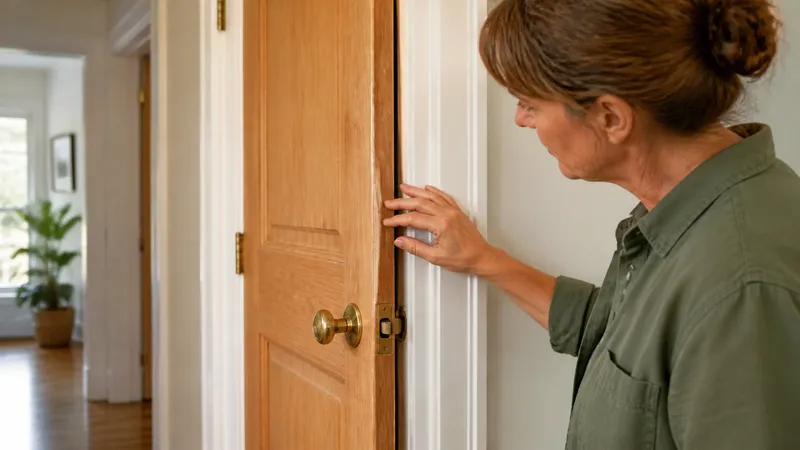
Doors sticking every summer is almost always wood swelling from humidity, not damage. Here's how to tell that apart from a settling foundation.
Key takeaways
- A door that sticks every summer and closes fine every winter is almost always wood swelling from humidity, not damage.
- Wood is hygroscopic: it absorbs moisture from humid air and swells, then gives it back and shrinks in dry winter heat.
- Solid wood doors and frames move more than hollow-core or fiberglass doors, which is why the same house can have one sticky door and five fine ones.
- A gap that is even all the way around but the door still binds is humidity. A door that sticks only at one diagonal corner is a different problem.
- Diagonal sticking, new drywall cracks over the frame, or sticking that keeps getting worse across seasons points to the frame going out of square, not humidity.
- Planing wood off a door that only swells seasonally usually leaves it loose and drafty every winter—fix the frame or clearance instead.
A door that sticks in July and swings freely in January is almost always wood swelling from summer humidity, not a sign anything is wrong with the house. Wood is hygroscopic—it absorbs water vapor from humid air and swells, then releases that moisture and shrinks back as the air dries out in winter heating season. Solid wood doors and door frames move the most, which is why one door in the house can stick every summer while a hollow-core or fiberglass door two rooms over never does. This is normal seasonal behavior, and it’s a different problem from a door that sticks diagonally or is getting worse year over year, which can point to the house frame going out of square.
Why humidity makes a door swell
Wood is made of cellulose fibers that absorb and release water vapor from the surrounding air until the wood reaches a moisture balance with that air—what wood scientists call equilibrium moisture content. As relative humidity rises, wood pulls in more moisture and its cells swell; as humidity drops, it gives that moisture back up and shrinks. The USDA Forest Products Laboratory’s Wood Handbook documents this moisture-to-dimension relationship in detail: wood shrinks and swells with changes in moisture content below the fiber saturation point, and that swelling is not uniform in every direction—it is roughly twice as strong across the grain (tangentially) as it is along the radius of the log the board was cut from. A door stile or frame jamb is cut with its width running across the grain, which is exactly the direction where humidity has the biggest effect. That’s why the width of a door—the dimension that determines whether it clears the frame—is the measurement most likely to change with the seasons, while the door’s height barely moves at all.
Moisture content changes of only a few percentage points are enough to swell a solid wood door measurably across its width, per Forest Products Laboratory research summarized by extension wood-science programs. A door and frame built or hung during a dry winter, when the wood was at its smallest, will fit tighter once summer humidity pushes moisture back into the wood—sometimes tight enough to bind against the strike side or drag on the threshold.
Why some doors stick and others in the same house don’t
| Door type | How much it moves with humidity | Why |
|---|---|---|
| Solid wood (interior or exterior) | Most movement | Full-thickness wood absorbs and releases moisture across its whole width |
| Wood-veneer or engineered-core door | Moderate movement | The veneer face moves some, but the engineered core resists swelling better than solid lumber |
| Fiberglass or steel exterior door | Little to none | The skin doesn’t absorb moisture the way wood does; any binding is usually the wood jamb around it swelling, not the door itself |
| Hollow-core interior door | Least movement | Little solid wood mass to absorb moisture |
| Unfinished or bare wood edges | More movement than sealed doors | Paint, varnish, or sealant slows moisture exchange; an unsealed top or bottom edge lets humidity in and out fastest |
If only one or two solid-wood doors in the house stick every summer, that pattern—rather than something being uniquely wrong with that doorway—usually explains itself: it’s the door most exposed to humidity swings (a bathroom, an exterior door, an unsealed edge) or the one with the least clearance to begin with.
When it isn’t humidity: the frame going out of square
A house frame can shift slightly as a foundation settles, and even a small amount of movement—well under an inch—can twist a rectangular door opening into a slight parallelogram. When that happens, the door itself hasn’t changed shape; the frame around it has, so it no longer sits square in the opening. Foundation-repair and structural sources describe the same diagnostic: step back a few feet from the door and look at the gap between the door and frame along the top edge. Even, humidity-driven sticking shows a consistent gap all the way around, just too tight. A frame that’s gone out of square typically shows a wider gap on one side than the other, and the door binds hardest at one diagonal corner—often the top corner opposite the hinges, or the bottom corner on the hinge side.
When to call a professional
| Situation | Why it is not just a humidity fix |
|---|---|
| Door sticks hard at only one top or bottom corner, with a visibly wider gap elsewhere on the frame | Points to the frame itself being out of square, not wood swelling |
| Sticking is new or has been getting worse over several months, not just returning each summer | Progressive movement suggests something is shifting, not a seasonal cycle repeating |
| Cracks appear in the drywall or trim directly above or beside the door frame | A common companion sign to frame movement from settling |
| Trim is separating at a mitered corner, or the door frame itself looks twisted | Structural movement, not a maintenance item |
| Multiple doors across the house are affected in the same diagonal pattern | Suggests a broader shift in the structure rather than one humid room |
None of these signs are a DIY diagnosis you can finish yourself—settling and structural movement need someone who can assess the foundation directly, which is a separate job from adjusting a door. A full look at foundation cracks and what’s normal settling versus a real problem is its own topic; treat a diagonally sticking door as a reason to get that assessment, not as the assessment itself.
What to actually do about a seasonal sticker
Most humidity-driven sticking responds to small, reversible fixes before you touch the door with a plane:
- Find the exact contact point. Close the door slowly and watch where it binds—usually the top corner on the strike side or along the latch edge.
- Check the hinges first. Loose hinge screws let a heavy door sag slightly, which can look like swelling. Tighten them before assuming it’s moisture.
- Look for paint buildup, especially on the top and bottom edges where old coats accumulate and are rarely sanded.
- Sand lightly at the contact point only, if the door still binds after confirming hinges and paint aren’t the cause. Take off a little at a time and recheck—this is easy to over-correct.
- Reseal bare edges once the door closes freely again. A coat of paint or varnish on all six sides, including the top and bottom, slows how fast the wood takes on and gives up moisture, which reduces how much it swells the following summer.
For other systems issues that show up as a symptom in one part of the house rather than a clear single cause, see the home systems hub.
Frequently asked questions
Why does my door only stick in summer?
Wood absorbs moisture from humid summer air and swells, especially across the grain, which tightens the fit between a solid-wood door and its frame. In winter, indoor heating dries the air and the wood gives up that moisture and shrinks back, so the same door that stuck in July closes freely in January.
Is a door that sticks every summer a sign of a structural problem?
No, not by itself. Seasonal sticking that clears up on its own every winter is normal moisture movement in wood, not a structural issue. It becomes worth investigating further only if it starts happening year-round, gets worse every year, or the door sticks unevenly at one diagonal corner instead of all around.
How can I tell if a sticking door means my foundation is settling?
Step back and look at the gap between the door and frame. Even sticking all around the door, worse in summer, is humidity. A door that sticks at only one top or bottom corner, a gap that widens diagonally, new cracks in the drywall above the frame, or trim pulling away at a corner are signs the frame itself has gone out of square, which points toward foundation movement rather than seasonal wood swelling.
Should I plane down a door that sticks in summer?
Not as a first step. If the sticking is seasonal, planing removes wood that the door needs back in winter, and you’ll end up with a door that’s loose and drafty for half the year. Try easing hinges, checking for paint buildup, and light sanding at the exact contact point first; only plane if the door still binds after a full dry season shows it isn’t swelling-related.
What’s a normal amount for a door to swell with the seasons?
There’s no single number every door follows—it depends on the wood species, how the door was sealed, and how humid the house gets—but moisture content changes of just a few percentage points are enough to swell solid wood measurably across its width, according to USDA Forest Products Laboratory research on wood and moisture. A door that binds at one edge in August and swings free in January is within that normal range.