
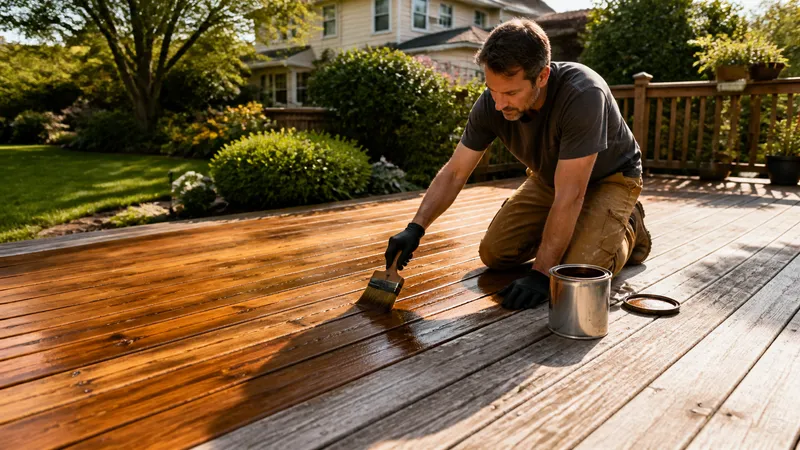
Deck maintenance by material: pressure-treated wood needs cleaning and stain or seal every 1-3 years; composite needs cleaning only. Plus the safety check.
Key takeaways
- Pressure-treated wood: clean yearly, stain or seal every 1-3 years depending on sun and foot traffic.
- Composite and PVC decking: clean twice a year, never stain or seal—the cap layer is not made to take a coating.
- The safety check matters more than the finish: inspect the ledger board attachment, post bases, and railing every year regardless of material.
- An estimated 90% of deck collapses trace back to a failed ledger board connection, per NADRA.
- Water beading on wood means the seal is still working. Water soaking in fast means it's due now, not on a fixed calendar date.
- Stop and call a professional for ledger separation, soft or heaving posts, or any bounce or sway that feels new.
A deck maintenance schedule splits by material, not by a single universal rule. Pressure-treated wood decks need cleaning plus a fresh stain or sealer roughly every 1 to 3 years, depending on sun exposure and foot traffic. Composite and PVC decking need cleaning only—no staining or sealing, ever—which is the single most common thing homeowners get wrong and the easiest way to waste money on a deck that doesn’t need it. Separate from both of those cosmetic schedules is the one check that matters for every material: the structural safety inspection, especially the ledger board connecting the deck to the house. That check belongs on the calendar every year no matter what the deck surface is made of.
Deck maintenance by material
| Material | Cleaning frequency | Stain/seal frequency | Notes |
|---|---|---|---|
| Pressure-treated wood | At least once a year; twice (spring and fall) in shaded, high-pollen, or high-mildew climates | Every 1-3 years—closer to 1-2 years in full sun or high traffic, up to 3 years if shaded or covered | Reseal when water no longer beads on the surface and soaks in within a few seconds |
| Cedar / redwood | Once or twice a year | Every 1-2 years—these softwoods weather and gray faster than pressure-treated pine | A clear or semi-transparent finish shows the grain but needs more frequent reapplication than solid stain |
| Composite (capped, e.g. Trex, TimberTech) | At least twice a year (spring and fall), per Trex care guidance | Never—composite is engineered not to accept stain or sealer | Staining a capped composite board doesn’t penetrate and can void the manufacturer warranty |
| PVC | Twice a year, soap and water or a mild composite/PVC cleaner | Never | Same logic as composite: fully synthetic decking has no wood grain to protect |
Pressure-treated wood is the material most homeowners overspend on maintaining a little too casually and underspend on the safety check that actually matters. A deck can look freshly stained and still have a ledger board that’s one storm away from pulling loose. Composite is the opposite problem: it’s genuinely low-maintenance, but “low-maintenance” gets mistaken for “no maintenance,” and even a composite deck’s structural frame is still wood underneath—so the safety check below still applies.
When to reseal a wood deck: read the wood, not the calendar
The 1-3 year range is a starting point, not a fixed date. Behr and Thompson’s WaterSeal both frame it the same way: 2-3 years is typical for a semi-transparent finish, but full sun, high foot traffic, coastal air, and freeze-thaw winters shorten that toward 1-2 years, while a shaded or covered deck can stretch past 3.
The water test tells you which end of the range your deck is actually on: splash a cup of water on a dry board. If it beads and sits, the seal is still working. If it darkens and soaks in within a few seconds, the wood is due for cleaning and a new coat—regardless of how many years it’s been since the last one.
Cleaning a wood or composite deck
Cleaning is the step every material shares, and it’s what makes the stain (on wood) or the finish (on composite) last as long as it’s supposed to. Dirt, pollen, leaf tannins, and mildew left on the surface trap moisture against the boards.
- Wood: Sweep debris, then wash with a deck cleaner or mild soap and a stiff-bristle brush. If pressure washing, keep it around 500-1,200 PSI for softwoods and pressure-treated lumber—higher settings can gouge the grain and strip more wood fiber than intended.
- Composite/PVC: Soap and water or a composite-specific cleaner, applied with a soft-bristle brush. Avoid pressure washers rated above roughly 3,100 PSI, and keep the nozzle moving—concentrated high-pressure streams can etch the cap layer.
- Both: Rinse thoroughly and let the deck dry fully (at least a day, longer in humid climates) before applying any stain or sealer to wood.
The structural safety check (every material, every year)
This is the part of deck maintenance that has nothing to do with how the surface looks. The North American Deck and Railing Association (NADRA) publishes a Deck Evaluation Guide built around the components most likely to hide a serious defect, and recommends running through it as an annual inspection.
| Check | What to look for | Why it matters |
|---|---|---|
| Ledger board (where the deck attaches to the house) | Gaps between ledger and house, rust streaks, soft or dark wood, visible nail heads with no bolts or screws | NADRA puts an estimated 90% of deck collapses down to ledger connection failure, most often a ledger attached with nails instead of lag screws or through-bolts |
| Posts and footings | Posts that wobble, feel soft, or sit on a footing that’s cracked, heaved, or no longer buried at grade | A compromised footing shifts the whole deck’s load path; it’s the second most common structural failure point after the ledger |
| Beams and joists | Sagging, splitting, or visible rot, especially where joists meet the ledger or a beam | Hidden rot at connection points is easy to miss under decking boards |
| Fasteners and hardware | Rust, missing joist hangers, hangers with pulled or missing nails, any hardware that isn’t rated for exterior/ground contact | Corroded hardware loses holding strength well before it looks obviously broken |
| Railings and guards | Any wobble when pushed, loose balusters, gaps you could fit a fist through | Guardrail failures injure more people than full collapses because they’re more common and more sudden |
| Stairs | Loose treads, stringers pulling from the frame, a handrail that moves | Stairs take repeated impact loads that framing elsewhere doesn’t |
The U.S. Consumer Product Safety Commission’s injury-surveillance data (NEISS), as cited by deck-safety groups including NADRA, tracks thousands of emergency-room visits a year tied to deck, porch, and railing structural failures—on top of the CPSC recalls issued over the years for composite and vinyl railing products that degraded and cracked under sun and heat exposure. None of that is a wood-versus-composite argument; it’s a reason to physically test the ledger, posts, and railing by hand once a year, whatever the deck is made of.
Railing height and spacing if you’re rebuilding
If a railing is being replaced rather than repaired in place, it needs to meet current code, not just match what was there before. Per the International Residential Code, a guard is required on any deck 30 inches or more above grade, with a minimum height of 36 inches (some states, including California, require 42 inches), and openings small enough that a 4-inch sphere can’t pass through. Local amendments vary—confirm the exact number with your building department before you buy materials.
Caveats that change the schedule
| Situation | How it changes maintenance |
|---|---|
| Ground-level deck, minimal foot traffic | Cleaning and resealing can stretch toward the long end of the range; the safety check still applies |
| Hot tub, planters, or grill sitting directly on wood | Move them periodically and check underneath for trapped moisture and rot |
| Deck built before ~2000 | Older ledger attachments were more likely to rely on nails alone—prioritize that check first |
| Composite deck over a wood substructure | The composite boards don’t need staining, but the framing underneath is still wood and still needs the annual structural check |
When to call a professional
| Situation | Why it is not DIY |
|---|---|
| Ledger board separation, rust streaks, or nail-only attachment | Documented as the leading cause of deck collapse; reattachment is a structural repair, not a maintenance task |
| Soft, cracked, or heaving posts and footings | Footing repair changes the deck’s load path and often needs to meet current code |
| Any new bounce, sway, or movement you can feel | Structural movement is a stop-and-inspect situation, not something to monitor for another season |
| Railing that doesn’t meet current height or baluster-spacing code when being replaced | Code compliance on a guard is a permit-and-inspection matter in most jurisdictions |
Keep a record
| Log this | Why |
|---|---|
| Material and install/rebuild year | Tells you which maintenance column applies and how old the ledger connection is |
| Last cleaning and last reseal date | The water-bead test tells you it’s due; the date tells you if you’re ahead of schedule |
| Photo of the ledger board and post bases | The easiest way to spot new rust, gaps, or movement year over year |
| Any repair or hardware replacement | Useful for a future buyer, an insurer, or a deck builder doing the next inspection |
The systems hub covers the rest of the house’s structural and mechanical maintenance—roof, plumbing, electrical, and the other annual checks that don’t depend on the season.
Frequently asked questions
How often should I clean and reseal a wood deck?
Clean a pressure-treated wood deck at least once a year, more in heavy shade or high pollen areas. Reseal or restain every 1 to 3 years—closer to 1-2 years for decks in full sun or high foot traffic, and up to 3 years for covered or shaded decks, per manufacturer guidance from brands like Behr and Thompson’s WaterSeal.
Does composite decking need to be stained or sealed?
No. Composite decking from manufacturers like Trex is capped to resist moisture and UV fading and is not designed to accept stain or sealer. It needs regular cleaning—Trex recommends at least twice a year—but staining it wastes money and can void the warranty.
What is the most important deck safety check?
Check the ledger board attachment where the deck meets the house. NADRA and structural engineers cite ledger board connection failure as the cause of an estimated 90% of deck collapses, usually because the ledger was nailed instead of bolted or lag-screwed.
How do I know if my deck’s railing is up to code?
Most residential decks over 30 inches above grade need a guard at least 36 inches tall (42 inches in some states, including California), with openings that don’t allow a 4-inch sphere to pass through, per the International Residential Code. If you’re replacing a railing, check your local code before you build to the old height.
How often should I have a deck professionally inspected?
Do your own visual and physical check every year using a guide like NADRA’s Deck Evaluation Guide. Call a structural engineer or licensed deck builder if you find ledger separation, soft or shifting posts, or movement you can feel when people walk or gather on the deck.