
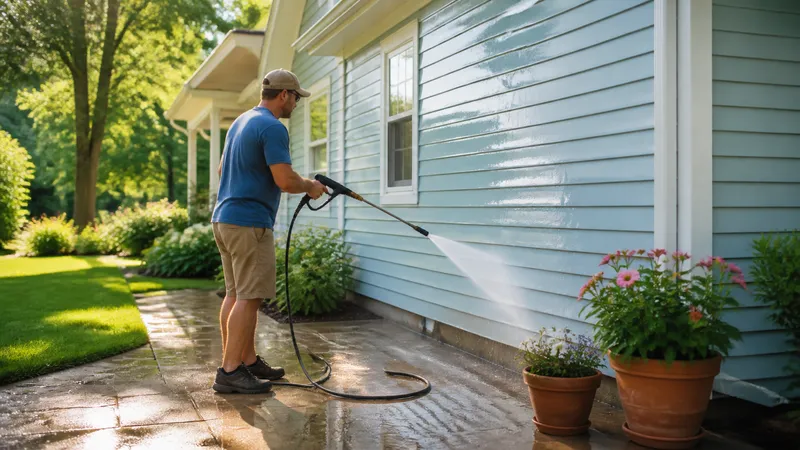
Power wash frequency by siding type—vinyl, wood, brick, stucco—plus safe PSI levels, a 2026 cost range, and when to call a pro.
Key takeaways
- Wash vinyl and painted siding about once a year; brick and fiber cement often go 2–3 years between washes.
- Never pressure wash asphalt shingles—GAF's own technical bulletin says it strips granules and can void the warranty.
- Keep brick masonry under 1,200 PSI, and 400–600 PSI on soft or historic brick, per the Brick Industry Association.
- Aim the wand level or downward, never upward under siding—trapped water causes leaks, mold, and rot.
- Expect $250–$800 to hire a pro for a full exterior wash in 2026; DIY rental is cheaper but adds ladder and shock risk.
- Use only GFCI-protected outlets, and wash sooner if you see green or black streaking or smell chalky mildew.
Most homes need a power wash about once a year, but the honest answer depends on what you’re washing. Vinyl, aluminum, and painted wood siding are usually annual jobs. Brick, stucco, and fiber cement often stretch to every 2–3 years. Roof shingles are not on a power-wash schedule at all—they get a separate low-pressure “soft wash” because standard PSI strips the granules that protect the shingle. Shaded, humid, or coastal homes move faster on every surface; sunny, low-humidity homes can stretch the interval. This page covers exterior surface cleaning specifically. For gutter and drainage upkeep, see the seasonal hub; for water intrusion or structural issues behind siding, see the systems hub.
How often by surface
| Surface | Typical interval | Watch for |
|---|---|---|
| Vinyl or aluminum siding | Every 1 year | Green/black streaking, chalky mildew smell, visible grime at eaves |
| Painted wood siding | Every 1–2 years | Peeling near washed areas, mildew in shaded corners |
| Brick | Every 2–3 years | Green algae in shaded or north-facing walls; efflorescence (white haze) is separate and not solved by pressure |
| Stucco | Every 2–3 years, soft wash only | Dark streaking, staining near downspouts |
| Fiber cement siding | Every 2–3 years | Manufacturer often limits PSI—check the install manual |
| Asphalt shingle roof | Soft wash only when streaked, not on a fixed calendar | Black streaks (algae), not just dirt—see the callout below |
| Concrete driveway/walkway | Every 1–2 years, tolerates higher PSI | Oil stains, moss in shaded cracks |
| Wood deck | Every 1 year, low PSI | Graying, mildew, raised grain from over-pressure |
Signs a wash is overdue
You don’t need a calendar reminder if the house tells you first. The most common tells: green or black streaking running down from the roofline or under gutters (usually algae or mold, not just dust), a chalky, musty smell near shaded walls, visible grime that a garden hose won’t rinse off, and dark staining concentrated where sprinklers or downspouts keep a wall damp longer than the rest of the house. Heavy tree cover and coastal humidity accelerate all of these—those homes are realistically on the shorter end of every interval in the table above, sometimes annually even for brick.
PSI and soft-wash guidance by surface
The reason “power wash” isn’t one setting is that too much pressure on the wrong surface causes real damage, not just a bad rinse.
| Surface | Safe PSI range | Source |
|---|---|---|
| Vinyl siding | 1,500–2,400 PSI, 40-degree tip, held level or angled down | Georgia-Pacific vinyl siding care guidance |
| Brick masonry (standard) | Up to 1,200 PSI | Brick Industry Association, Technical Note 20 |
| Brick masonry (soft/historic) | 400–600 PSI | Brick Industry Association, Technical Note 20 |
| Asphalt shingle roof | No pressure washing—soft wash with a cleaning solution instead | GAF technical bulletin on algae staining |
| Concrete/driveway | 2,500–4,000 PSI tolerated | General equipment guidance; test an inconspicuous spot first |
Georgia-Pacific’s siding guidance is specific about direction, not just pressure: hold the wand level with the siding and never angle it upward, because water forced up under a panel edge collects behind it—leading to leaks, hidden rot, and mold instead of a cleaner wall. That single mistake causes more real damage than choosing a slightly-too-high PSI.
Roofs are the surface where power washing is a genuine mistake, not just overkill. GAF’s own technical bulletin on algae staining says pressure washing strips the mineral granules that protect the shingle from UV and weather—and doing so can void the manufacturer’s warranty outright. The correct method for the dark streaking you see on older roofs (usually Gloeocapsa magma algae) is a low-pressure soft wash: a bleach- or surfactant-based solution applied and rinsed at low pressure, not blasted off. GAF’s own bulletin (linked above) recommends this route directly.
DIY vs. hiring a pro
Ground-level, single-story vinyl or a driveway is a reasonable DIY job with a rented or consumer pressure washer. It stops being DIY-friendly once you’re dealing with:
- Height. A second story, a steep roofline, or anything you’d need a ladder to reach directly with the wand. Kickback from the gun can push you off balance even on flat ground; on a ladder, that’s a fall risk.
- Electrical fixtures. Outdoor lights, meter boxes, and any outlet near the spray path. Water and unprotected connections don’t mix.
- The roof itself. As above, this is a soft-wash job for a pro with the right chemical dilution, not a homeowner with a rental unit.
- Older or historic masonry. Getting PSI and standoff distance wrong here erodes mortar you can’t easily replace.
Working safely (if you DIY)
| Practice | Why it matters |
|---|---|
| Wear safety glasses or goggles | Flying grit and return spray are the most common pressure-washer eye injuries |
| Stand 2–3 feet back, widest fan tip first | Reduces the chance of etching siding or driving water into seams |
| Never point the wand upward under siding, soffits, or shingles | Forces water behind the surface—the leading cause of hidden rot and mold |
| Plug into a GFCI-protected outlet only | Pressure washers combine water and electricity; CPSC has flagged missing GFCI protection as a shock and electrocution hazard |
| Keep the wand off ladders | Recoil can push you off balance; work upper stories with an extension wand or hire a pro with a lift |
| Test an inconspicuous spot first | Confirms the PSI and nozzle you picked won’t mark the specific paint or material on your house |
2026 cost range
| Job | Typical 2026 range | What moves the price |
|---|---|---|
| Full house exterior wash (pro) | $250–$800, national average near $300–$350 | Square footage, number of stories, siding type, region |
| Roof soft wash (pro) | Often priced separately from siding, by roof size and pitch | Steep pitch, algae severity, access |
| Driveway or walkway only | Lower end of the range above | Stain removal and oil spots add labor |
| DIY rental (weekend) | Usually well under $100 for the equipment | Your time, ladder/access limits, and safety gear |
Source: Angi’s 2026 pressure washing cost guide. Treat the national figure as a starting point—get a written, itemized quote before booking, since two-story homes, heavy algae, and difficult access all push the price above the average.
When to call a professional
| Situation | Why it is not DIY |
|---|---|
| Asphalt shingle roof with algae streaking | Requires a soft-wash chemical mix, not pressure—wrong method voids the shingle warranty |
| Second story or steep roofline | Fall risk from a ladder combined with wand recoil |
| Outdoor electrical fixtures or panels in the spray path | Shock risk without proper isolation |
| Historic or soft brick, old mortar joints | Wrong PSI erodes mortar you cannot cheaply replace |
| Stucco with visible cracks | Water intrusion behind cracked stucco is a moisture problem, not a cleaning one |
| Persistent mold smell after washing | May indicate moisture already trapped behind the siding, not just surface growth |
Keep a record
A power wash is easy to forget the moment the house looks clean again. Note the date, the surface, and the PSI or method you used—especially for a roof soft wash, since that receipt matters if you ever need to show a manufacturer the roof wasn’t pressure washed.
Related guides
Frequently asked questions
How often should you power wash a house?
Most vinyl, aluminum, and painted wood siding benefits from a wash about once a year. Brick, stucco, and fiber cement often go 2–3 years unless algae, mildew, or heavy shade speeds things up. Roof shingles use a separate low-pressure or soft-wash schedule, not annual power washing.
Can you pressure wash a roof?
Not with a standard high-pressure nozzle. GAF’s technical bulletin on algae staining warns that pressure washing dislodges the protective granules on asphalt shingles, which shortens roof life and can void the manufacturer warranty. Roofs use a soft wash: low pressure plus a cleaning solution.
Is it bad to pressure wash brick?
High pressure can be. The Brick Industry Association caps most cleaning at 1,200 PSI and recommends 400–600 PSI on softer or historic brick, because higher pressure erodes mortar joints. Modern hard-fired brick tolerates more than old lime-mortar brick does.
How much does it cost to power wash a house in 2026?
A professional whole-house wash typically runs $250–$800, with a national average near $300–$350, depending on square footage, siding material, number of stories, and region. Renting a pressure washer for a weekend DIY job usually costs well under $100, plus your time and safety gear.
Can I pressure wash vinyl siding myself?
Yes, for most single-story vinyl siding. Georgia-Pacific’s care guidance sets 1,500–2,400 PSI with a 40-degree tip, held level or angled down—never upward, which forces water behind the panels. Anything above the first story or near a power line is a better fit for a pro with the right lift or extension equipment.