
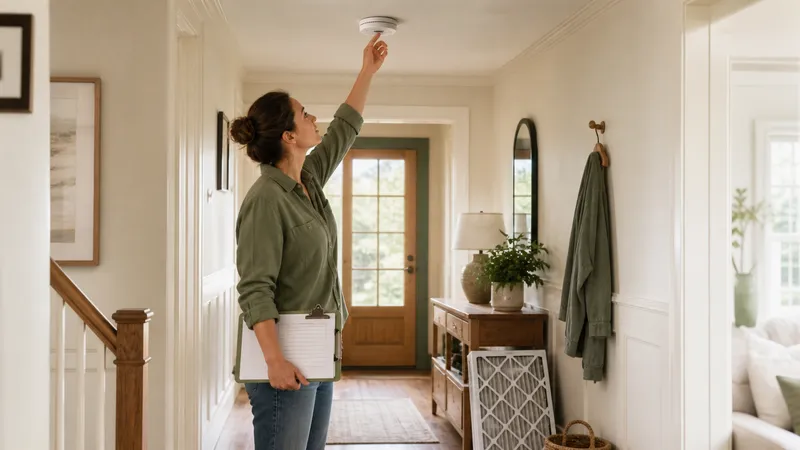
The monthly home maintenance checklist, room by room: alarms, filters, GFCIs, and leak checks—with why monthly is the right interval for each.
Key takeaways
- Run a 15-minute monthly walk-through: alarms, HVAC filter, GFCIs, and a leak check under every sink.
- Monthly tasks exist because small failures compound fast—an untested alarm or a blocked lint screen is a fire risk within weeks, not seasons.
- The monthly list does not change with the seasons; it is the constant baseline under the spring, summer, fall, and winter work.
- Test every GFCI with its TEST button monthly; if RESET will not hold power, call an electrician.
- Clean the dryer lint screen every load, not monthly—CPSC ties lint buildup directly to dryer fires.
- Log the date each month. A checklist you cannot prove you ran is just a good intention.
A monthly home maintenance checklist covers five repeating tasks: test smoke and CO alarms, check the HVAC filter, clean the dryer lint screen every load, test GFCI outlets, and walk the house for new leaks. This page is the monthly deep dive. The year-round master checklist summarizes this same list in one table; the seasonal guides own the weather-timed work that layers on top of it. Here, the question is why monthly is the right interval for each task, what a full room-by-room monthly pass looks like, and how to actually keep the habit once the new-house novelty wears off.
Why monthly, specifically
Most home maintenance tasks are timed to something: a season, a manufacturer interval, or a manufacture date. The monthly list is timed to how fast small failures compound.
A smoke alarm’s battery or sensor can fail silently between tests—that is exactly why the U.S. Fire Administration recommends testing the alarm monthly and replacing the whole unit 10 years from its manufacture date. A dryer lint screen builds a fire-feeding layer of lint after every single load, which is why the Consumer Product Safety Commission treats lint buildup in the dryer or duct as a direct overheating and fire risk, not a seasonal chore. A slow drip under a sink can go from a stain to warped cabinetry to a mold problem in the weeks between seasonal checks—EPA’s WaterSense program notes that household leaks waste nearly 1 trillion gallons of water nationwide each year, much of it from small, easy-to-miss sources like worn toilet flappers and dripping faucets. None of these wait for a season change.
Contrast that with seasonal work: gutter clearing, exterior caulking, and cooling or heating system startup are tied to weather and building exposure, not to a failure rate that climbs week over week. That is the real difference between the monthly list and the seasonal one—not that one is “more important,” but that one is timed to risk accumulation and the other is timed to weather.
The monthly walk-through, room by room
The master checklist gives you the short version in one table. Here it is organized the way you’ll actually walk the house—by zone—so nothing gets skipped because it wasn’t in the room you started in.
| Zone | Task | Why monthly | Source or rule of thumb |
|---|---|---|---|
| Utility closet / mechanical room | Check the HVAC filter; replace if gray or clogged | Airflow loss compounds fast and strains the blower motor | DOE Energy Saver: clean or replace once a month or as recommended |
| Utility closet / mechanical room | Look at the water heater base and connections for new moisture | A slow tank leak gets worse, not better, on its own | Master annual jobs table covers the deeper flush schedule |
| Kitchen | Test GFCI outlets near sinks; press TEST, then RESET | Verifies shock protection is still working before it’s needed | CPSC and manufacturer guidance both point to monthly GFCI testing |
| Kitchen | Open the cabinet under the sink and feel for dampness | Cabinet leaks are often invisible until the wood swells | Homeowner rule of thumb, not a federal standard |
| Bathrooms | Test GFCI outlets; check toilet base and supply lines for seepage | Toilet flapper leaks are common and easy to miss | EPA WaterSense: check toilet flappers periodically; replace at least every five years |
| Utility / laundry room | Clean the dryer lint screen (every load, confirm it’s part of the routine) | Lint accumulates every cycle, not every month | CPSC: lint buildup is a direct overheating and fire risk |
| Laundry room | Check washer supply hoses for bulging or cracking | Rubber hoses degrade gradually, then fail suddenly | Homeowner rule of thumb; replace at first sign of wear |
| Garage | Test GFCI outlets; scan for anything blocking the water heater or furnace combustion air | Garages collect stored items that can restrict airflow or ignite | Homeowner rule of thumb |
| Whole house | Test every smoke and CO alarm with its test button | Battery and sensor failures are silent until tested | USFA: test monthly; replace the unit 10 years from manufacture |
| Whole house | Walk each room once for new odors, buzzing outlets, or flickering lights | Early electrical symptoms are a stop-and-call signal, not a DIY fix | See “When to call a professional” below |
That is nine stops, most of them under a minute each. The full loop—utility closet, kitchen, bathrooms, laundry, garage, whole-house pass—takes about 15 minutes once you know the route.
Monthly vs. seasonal: what actually changes with the weather
This is the point worth being explicit about: the monthly list does not change between January and July. The same alarms, the same filter check, the same lint screen, the same GFCI test, the same leak walk apply in every season. What changes seasonally is a separate layer of exterior and weather-driven work.
| Monthly list | Seasonal layer | |
|---|---|---|
| Timing driver | Failure-rate accumulation (fire, shock, small leaks) | Weather exposure (freeze, heat, storms, growing season) |
| Location | Mostly indoors: utility closet, kitchen, bath, laundry, garage | Mostly outdoors: gutters, exterior, HVAC startup/shutdown |
| Changes by climate? | No—same tasks everywhere | Yes—freeze-belt and hot-humid homes run different priorities |
| Where it’s owned | This page and the master checklist | Spring, summer, fall, winter |
If you only run one checklist all year, the monthly list is the one that protects against fire and shock. The seasonal layer protects the building envelope and the systems that only fail under weather stress. Both matter; they are not interchangeable.
Why homeowners skip it, and how to actually keep the habit
The monthly list fails for a predictable reason: none of the nine tasks are urgent on the day you skip them. A dead alarm battery doesn’t announce itself. A slightly grayer filter still blows air. That is exactly what makes the interval dangerous to skip—the cost shows up later, and by then it’s not a checklist item anymore, it’s a repair or an emergency.
Three things make the habit stick in practice:
- Anchor it to something that already happens monthly. Rent, mortgage, or a recurring bill date works well—you’re already looking at a calendar.
- Always walk the same route. Utility closet, kitchen, bathrooms, laundry, garage, whole-house pass. A fixed order means you notice when you’ve skipped a stop.
- Write down the date, not just “done.” A date lets you (or a technician later) tell whether the alarm that just failed was actually tested last month or the list quietly lapsed three months ago.
When to call a professional
The monthly walk-through is designed to be entirely DIY. It also exists to catch the early signs of problems that are not.
| What you find during the walk-through | Why it’s not DIY from here |
|---|---|
| GFCI outlet trips on TEST but will not hold on RESET | Indicates a wiring or device fault behind the outlet |
| Smoke or CO alarm fails a test repeatedly after a fresh battery | Sensor failure—replace the unit; if hardwired, an electrician may be needed |
| Burning smell, buzzing outlet, or warm switch plate | Electrical fire risk—stop and call an electrician |
| Active water leak, not just a stain | Plumber for the source; stop using the fixture if it’s near outlets or panels |
| Dryer runs long or clothes stay damp after cleaning the lint screen | Likely a blocked vent path, not a weak dryer—see the dryer maintenance hub |
| HVAC filter is due but the system won’t hold a new one, or you smell burning dust | Call HVAC service rather than force a filter change—see the HVAC hub |
| CO alarm actually sounds (not a test) | Leave the house immediately and call emergency services, per Ready.gov |
A visual check, a photo, and a booked appointment are often the right next step from a monthly walk-through finding. That is not a failure to do it yourself—it’s the walk-through doing its job.
Related guides
Frequently asked questions
What should I check every month in my house?
Test every smoke and CO alarm, check the HVAC filter, clean the dryer lint screen every load, test GFCI outlets, and look under sinks and around the water heater for new leaks. Budget about 15 minutes for the walk-through.
Why is monthly the right interval instead of seasonal?
Fire and small-leak risks build up in weeks, not months. A dead smoke alarm battery, a clogged lint screen, or a slow drip under a sink can turn into an emergency long before the next seasonal check would catch it.
Does the monthly checklist change between seasons?
No. The monthly list is the same in January and July—alarms, filter, lint screen, GFCIs, leak walk. What changes seasonally is separate exterior and weather-driven work covered in the spring, summer, fall, and winter guides.
How long does the monthly walk-through actually take?
About 15 minutes in most houses once you know the route: utility closet, kitchen, bathrooms, garage, then a quick exterior glance. The habit is easier to keep if you always do it the same order.