
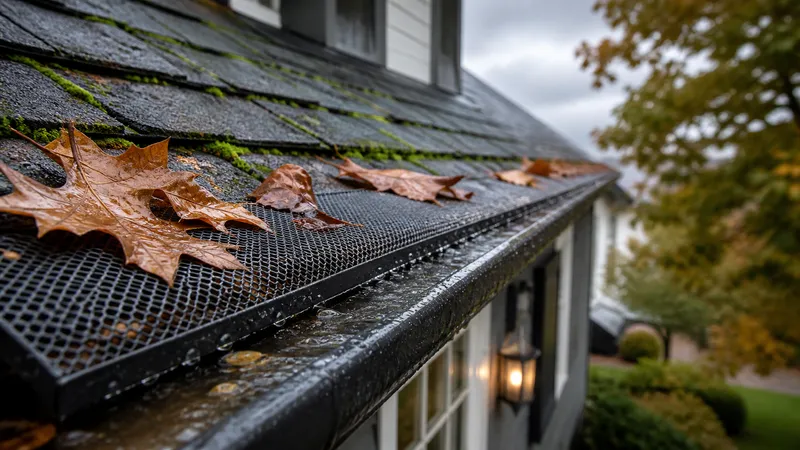
Gutter guards cut cleaning frequency but don't eliminate it. 2026 installed-cost ranges by type, the payback math, and where guards make sense.
Key takeaways
- Guards reduce cleaning frequency; they don't eliminate it—plan on checking guarded gutters at least once a year.
- 2026 installed costs run about **$19–$41 per linear foot** depending on guard type; a 200-ft house is roughly $3,800–$8,300.
- Foam and brush guards are the cheapest and most DIY-friendly; micro-mesh and reverse-curve cost more but shed debris better.
- Payback usually takes 5–10+ years compared to paying for cleanings, and only pencils out if you'd otherwise hire every cleaning.
- Reverse-curve guards can ice over at the intake slot in freezing climates and make overflow worse, not better.
- Heavy pine cover, a hard-to-access roof, or a homeowner who currently pays for cleanings are the strongest cases for guards.
Gutter guards are worth it if you’d otherwise pay for 2–4 professional cleanings a year and can leave them installed for 5–10+ years—but they reduce cleaning, they don’t end it. No guard on the market stops all debris; pine needles, seed pods, and fine grit still get through or collect on top. This page is about whether to install guards and what they cost. For how often to clean gutters that don’t have guards, see the gutter cleaning schedule guide, which owns cleaning cadence and DIY cleaning steps.
Gutter guard types and what they actually do
| Type | How it works | Debris it handles well | Where it struggles |
|---|---|---|---|
| Micro-mesh | Fine stainless or aluminum mesh sits over the gutter, blocking particles down to roughly the size of a grain of rice | Small debris, most leaf types | Fine grit and pollen can still cake the mesh surface over time |
| Screen | Coarser metal or plastic mesh, larger openings than micro-mesh | Large leaves | Pine needles and small seed pods pass through or wedge in the holes |
| Reverse-curve (surface tension) | A curved hood directs water around a lip into a narrow slot while debris slides off the front edge | Large leaves and debris that can’t cling to the curve | Freezing weather (see ice dam note below); slower-moving drizzle can overshoot the slot |
| Foam insert | A porous foam strip wedges into the gutter channel; water passes through, debris sits on top | Leaves, larger debris | Foam degrades with UV exposure and can hold moisture, growing mold or sprouting seedlings if not checked |
| Brush | A cylindrical bristle brush sits in the trough; debris catches on the bristles instead of settling in the channel | Leaves, twigs | Needs manual debris removal from the bristles more often than mesh or reverse-curve |
Gutter guard cost by type (2026)
| Guard type | Installed cost per linear foot | Installed cost for a 200-ft home | Source |
|---|---|---|---|
| Brush | $18.94 | ~$3,787 | This Old House, 2026 |
| Foam insert | $21.58 | ~$4,316 | This Old House, 2026 |
| Screen | $38.12 | ~$7,624 | This Old House, 2026 |
| Micro-mesh | $40.50 | ~$8,101 | This Old House, 2026 |
| Reverse-curve / surface tension | $41.22 | ~$8,244 | This Old House, 2026 |
| National average, all types, professionally installed | ~$40/ft | $6,414–$9,468 | This Old House, 2026 |
What moves the number: material choice, DIY versus a branded installer (This Old House’s data shows DIY saving roughly $1,200–$5,700 on a 200-ft job depending on type), stories and roof pitch, and total linear footage. A national average is a planning number—get a written quote for your actual gutter run before comparing types.
What guards still require
Every type still needs periodic attention—this is the part installer marketing tends to skip. Micro-mesh and screen block leaves but not shingle grit, pollen, or dust, which builds up on the guard surface. Pine needles and small seed pods are the hardest case for every guard type; they’re thin enough to work through mesh openings and wedge in brush bristles. Foam and brush guards need debris pulled off the surface, not just a hose flush, since material sits on top instead of sliding off a curve. And downspouts can still clog even when the trough stays clear, since fine debris that passes through a guard collects at the narrowest point downstream.
At least one check per year is a reasonable default, more with heavy tree cover—less frequent than the cadence the gutter cleaning schedule guide lays out for open gutters, but not zero.
Payback: guards vs. paying for cleanings
The gutter cleaning schedule guide cites This Old House’s 2026 gutter cleaning cost data: professional cleaning runs about $145–$250 for a single story and $180–$360 for two stories per visit. Compare those figures against the guard cost table above.
| Scenario (200 ft of gutter, two-story home) | Cost without guards over 10 years | Cost with guards over 10 years | Notes |
|---|---|---|---|
| Hire a pro to clean twice a year, no guards | ~20 visits × $270 avg = $5,400 | — | Baseline: heavy tree cover, no guards |
| Install micro-mesh guards ($8,101), then hire a pro to check once a year | — | $8,101 + 10 checks × $270 = $10,801 | Guards cost more here—checks still need ladder access if two stories |
| Install brush guards ($3,787), then check it yourself once a year | — | $3,787 (DIY checks, no added labor cost) | Guards pay for themselves versus hiring, if you can DIY the annual check |
| Clean your own gutters twice a year already (no cash cost, just time) | $0 cash, ~1–2 hrs/year | $3,787–$8,244 install cost | Guards cost real money to save time you’re already willing to spend |
This is illustrative, not a quote for your house. The pattern holds generally: guards pay back fastest when you currently hire every cleaning and can install a cheaper type yourself; they pay back slowest or never if you already clean your own gutters for free.
Where guards make the most and least sense
| Situation | Guards make more sense | Guards make less sense |
|---|---|---|
| Tree cover | Heavy deciduous cover overhanging the roof | Little to no overhanging tree cover |
| Roof access | Two-story, steep, or otherwise hard to reach safely | Single-story with easy ground-level access |
| Who currently cleans | You currently pay a pro every time | You already clean it yourself in under an hour |
| Needle-dropping conifers nearby | Marginal case—no guard fully solves pine needles, but brush and tight micro-mesh reduce buildup somewhat | N/A |
| Cold, freeze-prone climate | Choose a low-profile, close-to-roofline design rather than a reverse-curve/surface-tension type | If ice dams aren’t a concern, guard type matters less |
DIY vs. professional installation
| Guard type | DIY difficulty | Why |
|---|---|---|
| Foam insert | Easy | Cuts to length and wedges into the existing channel from a stable ladder; no fasteners into the fascia |
| Brush | Easy | Drops into the trough; no permanent attachment |
| Screen | Moderate | Usually clips or screws onto the gutter lip; workable on a single-story home |
| Micro-mesh | Moderate to hard | Needs precise fastening to keep the fine mesh taut and sealed at seams |
| Reverse-curve / surface tension | Hard | Mounts to the fascia, sometimes under the drip edge—misalignment causes the overflow problems above |
When to call a professional
| Situation | Why it’s not DIY |
|---|---|
| Two-story or steep-pitched roofline | Ladder fall risk during installation, same as any gutter work |
| Reverse-curve systems that mount under the shingle drip edge | Misalignment causes water to miss the slot entirely; may require lifting roofing material |
| Existing gutters with sagging sections or loose fasteners | Guards add weight; hang the gutter correctly first or the combined load can fail |
| You’re not sure the guard is compatible with your gutter profile (K-style vs. half-round) | Wrong fit causes water to shoot past the gutter instead of into it |
Related guides
Frequently asked questions
Are gutter guards worth the money?
It depends on what you’re comparing them to. If you currently pay a pro $145–$450 per cleaning visit and do it 2–4 times a year, guards can pay for themselves in roughly 5–10 years. If you already clean your own gutters twice a year in 30–60 minutes, the math is much weaker.
Do gutter guards eliminate the need to clean gutters?
No. Every guard type still lets fine grit, pollen, and shingle debris through, and larger debris collects on top of the guard itself. Most manufacturers and installers recommend checking guarded gutters at least once a year, more with heavy tree cover.
How much do gutter guards cost installed in 2026?
Professional installation runs roughly $19–$41 per linear foot depending on type, or about $3,800–$8,300 for a 200-linear-foot home, according to This Old House’s 2026 cost data. Foam and brush inserts are the cheapest; micro-mesh and reverse-curve systems cost the most.
Can gutter guards make ice dams worse?
Some designs can. Reverse-curve and surface-tension guards route water over a narrow lip into the gutter; in freezing weather that lip can ice over first, sealing the opening and forcing meltwater to back up and refreeze at the roof edge instead of draining.
Should I install gutter guards myself or hire a pro?
Ground-level, single-story gutters with a stable ladder setup are a reasonable DIY job for snap-in mesh, foam, or brush guards. Two-story homes, steep pitches, or fascia-mounted reverse-curve systems that need precise alignment are worth hiring out.