
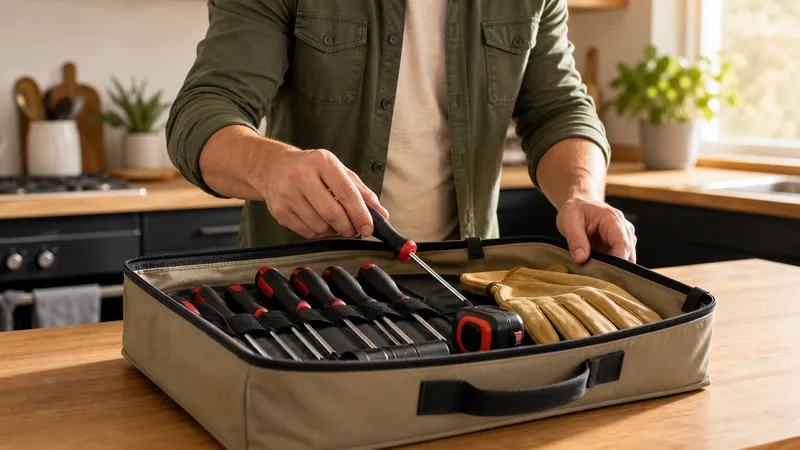
Home maintenance for beginners with zero DIY experience: the starter tool kit, how to tell safe DIY from call-a-pro, and how to build confidence over time.
Key takeaways
- You don't need a full workshop to start—a $75-$150 starter tool kit covers the vast majority of first-year homeowner tasks.
- Sort every task into one of three buckets: safe to learn on your own, safe with the right tool and manual, or always a licensed pro's job.
- The manufacturer's manual, not a general blog post, is the correct source for your specific appliance's filter size, service interval, and reset procedure.
- Build confidence on low-risk, reversible tasks first—replacing a filter or caulking a gap—before moving to anything involving water, gas, or electricity.
- CPSC data shows ladder-related injuries alone send more than 90,000 people to U.S. emergency rooms every year—basic ladder rules aren't optional caution, they're the actual injury data.
- Keep a running note of what you tried, what worked, and what a pro ultimately fixed—that record is what turns 'beginner' into 'experienced homeowner' fastest.
Home maintenance for a true beginner starts with three things, not a checklist: a small starter tool kit, a clear rule for sorting tasks into “safe to learn” versus “always call a pro,” and a habit of checking the manufacturer’s manual before a general blog post. You don’t need to know how a furnace works to own one—you need to know which of its problems are yours to touch and which aren’t, and that distinction is learnable in a weekend.
The starter tool kit
You don’t need a workshop. A short list of tools handles most of what comes up in a first year of homeownership; you can add specialty tools as specific tasks require them.
| Tool | Typical 2026 cost (mid-range) | What it’s for |
|---|---|---|
| Screwdriver set (Phillips + flathead, multiple sizes) | $10-$20 | Cabinet hardware, outlet covers, appliance panels |
| Adjustable wrench + pliers | $15-$30 | Loose fittings, supply-line nuts, general tightening |
| Cordless drill/driver | $40-$80 | Shelving, curtain rods, deck boards, most assembly tasks |
| Stud finder | $15-$25 | Anything mounted to drywall that needs to actually hold weight |
| Tape measure + level | $10-$20 | Furniture placement, picture hanging, checking anything “off” |
| Flashlight or headlamp | $10-$20 | Attic, crawlspace, basement, and behind-appliance checks |
| Plunger + drain snake | $15-$25 | Basic clog clearing before it becomes a call-a-plumber situation |
| Multimeter | $15-$25 | Testing an outlet or checking if a breaker actually tripped (not for opening a panel) |
Total starter cost typically runs $75-$150 for the core set in 2026, depending on brand and whether you buy a pre-assembled kit or individual pieces. Regional big-box pricing varies; treat this as a planning range, not a quote.
Sort every task into one of three buckets
The biggest skill gap for beginners isn’t tool knowledge—it’s not having a system for deciding what’s theirs to try. Use this filter on any task you’re facing for the first time:
| Bucket | What belongs here | Examples |
|---|---|---|
| Safe to learn on your own | Reversible, low-risk, no specialized system involved | Replacing an HVAC filter, caulking a gap, tightening a cabinet hinge, testing GFCI outlets with the built-in test button |
| Safe with the right tool and manual | Requires a specific part, tool, or manufacturer instruction, but no sealed or hazardous system | Replacing a toilet fill valve, resetting a garbage disposal, clearing a slow drain, swapping a range hood filter |
| Always a licensed pro’s job | Gas, electrical panel interior, sealed refrigerant, structural, or anything beyond a stable low ladder | Gas line or pilot work beyond what the manual shows, breaker panel repairs, roof work, HVAC refrigerant service |
When in doubt, the manufacturer’s manual is the tiebreaker. If it says “contact a qualified service technician” for a step, that line exists because the manufacturer has decided the risk or liability crosses a threshold—not because the company wants to sell you a service call.
Build confidence in this order
- Start with reversible, no-consequence tasks. Replace a filter. Re-caulk a gap. Reset a tripped GFCI. Nothing here can make things worse if you get a step wrong.
- Move to tasks with a clear manual. Most appliances ship with a troubleshooting section that walks through the exact steps for your model—follow it literally before improvising.
- Watch one task done correctly before you do it yourself, whether that’s a manufacturer’s video or a professional doing a service call you’re present for. Seeing the sequence once removes most of the hesitation.
- Keep a simple record. Note what you tried, what worked, and—when you called a pro—what they actually found. Over a year, this record becomes your own reference for the house, faster than starting from zero each time something comes up.
- Accept the “always call a pro” list without guilt. Calling a licensed electrician for a panel issue isn’t a beginner failure; it’s the correct move for every homeowner, beginner or not.
When to call a professional
| Situation | Why it’s not beginner DIY |
|---|---|
| Gas piping, a pilot light the manual doesn’t walk you through relighting, or any gas odor | Combustion and fuel lines carry fire and carbon monoxide risk that isn’t forgiving of a wrong guess |
| Inside an electrical panel, repeated breaker trips, or a warm outlet or switch | Panel work requires licensing in most jurisdictions and carries shock and fire risk |
| Roof access beyond a stable, low ladder with three points of contact | Falls from height are one of the most common serious home-maintenance injuries |
| Sealed HVAC refrigerant lines or the outdoor condenser’s internals | Refrigerant handling requires EPA certification; opening the sealed system yourself is both unsafe and, for refrigerant, federally regulated |
| Active leaks near electrical equipment, or any sewage backup | Combining water or waste with live power, or handling contaminated water, both carry health and shock risk |
A visual check, a photo for your own record, and a booked appointment are often the right next step for anything on this list. That isn’t a failure to “do it yourself”—it’s the same call an experienced homeowner makes.
Related guides
Frequently asked questions
What tools does a beginner homeowner actually need?
A starter kit covering a screwdriver set, adjustable wrench, pliers, a stud finder, a tape measure, a level, a flashlight, and a basic drill handles most first-year tasks—typically $75-$150 total in 2026 for mid-range tools. You can add specialty tools (a plunger, a multimeter, a shop vac) as specific tasks come up rather than buying everything up front.
How do I know if a repair is safe to DIY as a beginner?
Ask three questions: does it involve opening a gas line, an electrical panel, or a sealed refrigerant system; does it require working more than a few feet off the ground; and does the manufacturer’s manual explicitly say to call a service technician. A “yes” to any of those means call a pro. Everything else—filters, caulk, minor leaks under a sink with the water shut off, reassembling furniture—is reasonable beginner territory.
Where should I look up how to do a specific maintenance task?
Start with your appliance or system’s manufacturer manual, which you can usually find as a PDF by searching the model number. Manuals give the exact filter size, service interval, and safe reset steps for your specific unit, which is more reliable than a general blog post written for a different model.
Is it normal to feel overwhelmed by home maintenance as a first-time homeowner?
Yes, and it usually passes faster than new homeowners expect. Most of what feels overwhelming in month one is the sheer number of systems in a house, not the difficulty of any single task. Working through low-risk tasks first, and keeping a simple record of what you’ve learned about each system, builds real confidence within the first few months.
What’s the single biggest mistake beginner homeowners make with maintenance?
Either doing nothing until something breaks, or trying to tackle jobs that involve gas, electrical panels, or roofs before they have the experience or tools to do it safely. The middle path—learning the low-risk 80% of tasks yourself and calling a licensed pro for the rest without guilt—is what experienced homeowners actually do.