
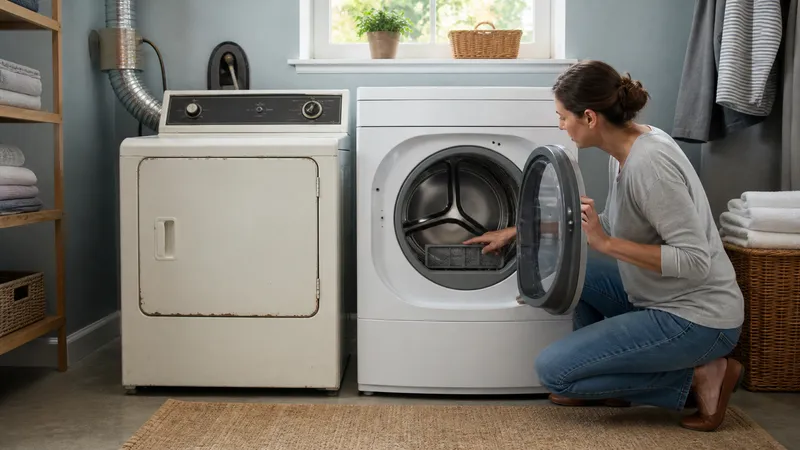
A dryer lasts about 13 years on average, gas or electric. What actually shortens that number, real repair costs by part, and the signs it's dying.
Key takeaways
- InterNACHI's life-expectancy chart lists 13 years for a clothes dryer—no separate gas vs. electric figure exists.
- A clogged vent or lint trap forces the heating element or burner to run hotter and longer, which is what actually shortens dryer life.
- Gas dryers fail at the igniter (common, $100–$250) or gas valve (rare, licensed technician only). Electric dryers fail at the heating element ($150–$350).
- A thermal fuse that keeps tripping is almost always an airflow problem, not a bad fuse—replacing it repeatedly without fixing the vent just repeats the failure.
- Apply the 50% rule: if a repair quote is at or above half the cost of a new dryer ($600–$1,500), replace instead of repair.
- Grinding drum noise, a burning smell that persists after cleaning, and dry times that stay long even with a clean vent are signs of a dying unit, not a dirty one.
A dryer typically lasts 13 years, according to InterNACHI’s life-expectancy chart—and that single figure covers both gas and electric models. There is no separate, documented lifespan gap between the two fuel types. What actually differs is how each one fails and what it costs to fix: gas dryers wear out igniters and, less often, gas valves; electric dryers wear out heating elements. Both types get shortened the same way—by restricted airflow forcing the heat source to run harder than it was designed to.
What actually shortens a dryer’s life
A dryer’s heating element or gas burner is built to run for a specific amount of time per cycle, moving a specific volume of air. CPSC explains the mechanism plainly: when lint blocks airflow in the dryer or the exhaust duct, it causes excessive heat build-up. That heat doesn’t just create a fire risk—it’s also the thing that ages a heating element, an igniter, and a motor faster than a normal, well-ventilated cycle would.
Two places cause this, on two different timescales:
- The lint trap, clogged with visible lint or invisible dryer-sheet residue, restricts airflow every single load. See How Often to Clean Your Dryer Lint Trap (and Vent) for the every-load habit and the water test that catches residue a trap can hide.
- The exhaust vent and duct, clogged further down the line, restricts airflow over months or years, and is a less frequent but higher-stakes job. See Dryer Vent Cleaning: How Often and Why It Prevents Fires for duct material, DIY limits, and professional cleaning costs.
This page doesn’t repeat either routine. It’s the deep dive on what those restrictions do to the appliance itself over its life, and what breaks first.
Gas dryer failure points
| Part | How it fails | Repair difficulty |
|---|---|---|
| Igniter | Wears out from repeated heating/cooling cycles; a common, relatively inexpensive gas-dryer repair | DIY-feasible for some models; many owners still call a technician for gas-adjacent work |
| Gas valve | Rare, but when it fails the dryer won’t ignite reliably or at all | Licensed technician only—this is gas supply hardware, not a homeowner repair |
An igniter that glows but fails to ignite the gas, or takes several tries, is the classic early symptom. It’s a well-understood, parts-available repair. A gas valve problem is different in kind: it’s fuel-supply hardware, and Fixr’s dryer repair cost guide notes that gas dryer repairs generally call for a qualified technician even for what looks like a simple fix, because a misdiagnosed gas component is a safety issue, not just a broken appliance.
Electric dryer failure points
| Part | How it fails | Repair difficulty |
|---|---|---|
| Heating element | Coil burns out from age and from running hotter than designed under restricted airflow | Repair is DIY-feasible on some models; other models bury the element behind a full cabinet teardown that favors a technician |
| Thermal fuse | Trips (opens) when the dryer overheats—repeated tripping is a symptom, not the disease | Cheap part, but replacing it without fixing the airflow problem just repeats the failure |
The thermal fuse point is worth sitting with: a fuse that blows once might be a fluke. A fuse that blows again within a few loads after replacement is the dryer telling you airflow is restricted somewhere—lint trap, vent, or duct—not that you got a bad fuse. Chasing the fuse instead of the airflow is a common, avoidable repeat repair.
Repair cost by component (2026)
| Component | Typical 2026 repair cost | Repair or replace |
|---|---|---|
| Igniter (gas) | $100–$250 (Fixr) | Repair—cheap relative to a new unit |
| Heating element (electric) | $150–$350 (Fixr; HomeGuide) | Repair on a dryer under ~10 years old |
| Thermal fuse | $75–$150 (HomeGuide) | Repair, but fix the airflow cause too |
| Drum belt | $100–$250 (Fixr; HomeGuide) | Repair |
| Motor | $150–$450 (Fixr; HomeGuide) | Borderline—compare against the 50% rule below |
| Gas valve | Not itemized by name in public cost guides; expect parts plus mandatory licensed labor, priced above an igniter repair | Repair, but only by a licensed technician—never DIY |
These are national estimator ranges built from public cost-guide data; a national average is not your quote. A new dryer typically runs $600–$1,500 depending on capacity and features, per the same estimator sources. Use the 50% rule: if a repair quote lands at or above half the price of a comparable new dryer, replacement is the better value—especially once the unit is past the 8–12 years most dryers are built for, even though InterNACHI’s chart puts the average closer to 13.
Signs of a dying unit
| Sign | What it usually means | Temporary/fixable or terminal |
|---|---|---|
| Loads take much longer to dry, even right after cleaning the lint trap and vent | If cleaning didn’t fix it, you’re looking at a worn heating element, burner, or motor rather than a blockage | Points toward a real part failure, not maintenance |
| Burning smell that persists after a thorough lint and vent cleaning | Once airflow is confirmed clear, a lingering burn smell points to an electrical or heating component, not lint | Stop using the dryer and have it inspected |
| Drum makes a grinding or squealing noise | Worn drum support rollers, bearings, or a glide bearing—mechanical wear, not an airflow issue | Usually repairable, but on an older unit it’s a 50%-rule decision |
| Repeated thermal-fuse trips after cleaning trap and vent | Restricted airflow somewhere upstream is still there, or the airflow path itself (duct length, kinks) is marginal | Fixable, but requires finding the actual restriction, not just swapping fuses |
When to call a professional
| Situation | Why it’s not DIY |
|---|---|
| Gas valve or gas line component is suspected | Licensed technician only—misdiagnosed gas hardware is a safety issue, not just a broken part |
| Burning smell persists after lint trap and vent are confirmed clean | Points to an electrical or heating-element fault that needs diagnosis, not another cleaning pass |
| Drum grinding or squealing, especially on a dryer over 8–10 years old | Bearing or roller wear often means a teardown; weigh against the 50% replacement rule first |
| Breaker trips repeatedly or you see scorch marks | Electrical fault—stop using the dryer and have it inspected before running another load |
| Repair quote is at or above 50% of a new dryer’s price | Financially, replacement is the better call regardless of which part failed |
Related guides
Frequently asked questions
Do gas dryers last longer than electric dryers?
No. InterNACHI’s life-expectancy chart lists one figure for clothes dryers, 13 years, with no separate line for gas or electric. The two types fail differently—igniters and gas valves on gas models, heating elements on electric ones—but neither has a documented lifespan advantage over the other.
What shortens a dryer’s lifespan the most?
Restricted airflow. A clogged lint trap or a blocked exhaust vent forces the heating element or gas burner to run longer and hotter than it was designed for on every load, which accelerates wear on the same parts that eventually fail. Keeping the trap and vent clear is the single biggest lifespan lever a homeowner controls.
Why does my dryer keep blowing the thermal fuse?
A thermal fuse trips when the dryer overheats—it’s a safety response, not a random defect. If a new fuse blows again within a few loads, the underlying cause is almost always restricted airflow in the vent or a clogged lint trap, not a faulty fuse. Replacing the fuse without clearing the airflow path just repeats the failure.
Is it worth repairing a 10-year-old dryer?
Apply the 50% rule: if the repair quote is at or above half the price of a new dryer (roughly $600–$1,500 for most models), replacement is the better value, especially once the unit is past the 8–12 year range most dryers are built for. A single-part repair under that threshold on a unit under 10 years old is usually still worth it.