
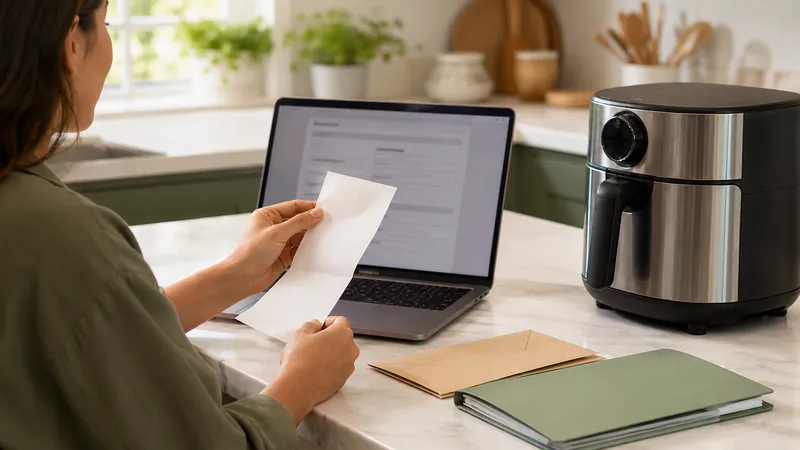
Proof of purchase for a warranty claim means the receipt, purchase date, and model/serial number together—what counts, and what to do if you lost the receipt.
Key takeaways
- A valid proof of purchase for most warranty claims is the receipt or invoice showing the purchase date, plus the model and serial number matching the unit—not the receipt alone.
- A credit card or bank statement showing the charge, date, and retailer is commonly accepted as backup when the original receipt is lost.
- Manufacturers can legally require proof of purchase to honor a written warranty, but under FTC rules they can't require you to use only their branded parts or service to keep coverage valid.
- Photograph the receipt and the appliance's model/serial label the week you buy it—reconstructing this months or years later is the hardest part of any claim.
- Digital order confirmations count as proof of purchase for most manufacturers; save the email itself, not just a mental note that you ordered online.
Proof of purchase for a warranty claim is usually the receipt or invoice showing the purchase date and retailer, matched to the appliance’s model and serial number—not the receipt alone. Manufacturers use these together to confirm you’re within the coverage window and that the claim matches the actual unit. If you’ve lost the original receipt, a credit card statement, order confirmation email, or the retailer’s account history commonly works as a substitute.
What counts as proof of purchase
| Document | Accepted for most warranty claims? | Notes |
|---|---|---|
| Original paper receipt | Yes | The most straightforward form; keep it with the model/serial info |
| Digital order confirmation email | Yes | Functions the same as a paper receipt for most manufacturers |
| Retailer account order history | Usually | Available if you bought with a loyalty account or online profile |
| Credit card or bank statement | Usually, as backup | Shows charge amount, date, and retailer—accepted when the original receipt is lost |
| Gift receipt | Often, for gifted items | Shows purchase date and retailer without the price |
| Verbal statement of purchase date, no documentation | Rarely sufficient alone | Some manufacturers will attempt to verify by serial number and product registration instead |
The model and serial number matter as much as the purchase date. A receipt proves when and where you bought something; the label on the unit itself proves which specific item the claim is about. Finding that label is worth doing before you call, not during the call.
If you’ve lost the original receipt
Losing a paper receipt doesn’t automatically end a warranty claim. Work through these in order:
| Source | How to check |
|---|---|
| Search your inbox for the retailer’s name and the approximate purchase month for an order confirmation | |
| Credit card or bank statement | Look for the charge amount and retailer name around the purchase date; most statements are searchable online going back a year or more |
| Retailer account history | If you bought online or with a loyalty account, check the retailer’s website order history—many keep records for years |
| The retailer directly | Some retailers can look up a transaction using your name, card number, and approximate date, even without an account |
| Product registration | If you registered the product when you bought it, the manufacturer may already have a purchase date on file |
What manufacturers can and can’t require
Federal Trade Commission rules under the Magnuson-Moss Warranty Act govern how manufacturers can condition a written warranty. Two points matter most for homeowners:
| Rule | What it means |
|---|---|
| Manufacturers can require proof of purchase | To honor a written warranty, they can ask for reasonable documentation that you bought the product and when |
| Manufacturers generally can’t require brand-name parts or service only | Under the FTC’s guidance on the Magnuson-Moss Warranty Act, a warranty can’t be conditioned on using only the manufacturer’s branded parts or authorized service unless those are provided free of charge—an independent repair or third-party part doesn’t automatically void coverage |
The FTC’s consumer guidance notes that a manufacturer can still deny a specific claim if it can demonstrate the independent part or service actually caused the problem being claimed (FTC: Warranty Basics). The rule protects your right to shop around for repairs; it doesn’t protect a claim caused by that repair.
When to call a professional
| Situation | Why it’s not a DIY paperwork fix |
|---|---|
| Manufacturer disputes your bank statement or order history as valid proof | Contact the manufacturer’s warranty department directly and ask what specific documentation they require; escalate to a supervisor if a rep denies a claim outright |
| Manufacturer claims your independent repair voided the warranty | Ask them to show how the specific repair caused the defect, per Magnuson-Moss Warranty Act rules; if they can’t, that’s not valid grounds for denial |
| A retailer can’t locate your purchase and the manufacturer requires it | File a complaint with your state attorney general’s consumer protection office or the FTC if you believe the denial is improper |
| The item came with the house and no prior owner records exist | A technician can sometimes verify remaining warranty by serial number during a service call, even without a purchase record on hand |
Related guides
Frequently asked questions
What exactly counts as proof of purchase for a warranty claim?
Most manufacturers accept a receipt or invoice showing the purchase date, the retailer, and enough detail to match the item—often the model number. A digital order confirmation email works the same way as a paper receipt. Combined with the appliance’s model and serial number from its own label, that’s typically the full set a warranty claim needs.
I lost my receipt. What can I use instead to prove purchase?
A credit card or bank statement showing the charge amount, date, and retailer name is commonly accepted as backup proof of purchase. You can also check the retailer’s online account order history if you bought it with an account or loyalty program, or contact the retailer directly for a duplicate receipt if they can look up the transaction.
Can a manufacturer deny my warranty claim just because I don’t have the original paper receipt?
They can require some form of proof of purchase to honor a written warranty, since that’s how they verify the purchase date and that you’re within the coverage period. But a bank statement, order confirmation email, or retailer account history is usually an acceptable substitute for the original paper receipt—ask the manufacturer’s warranty department what they’ll accept before assuming a claim is dead.
Does using non-brand-name parts or an independent repair shop void my warranty?
Not automatically. Under the Magnuson-Moss Warranty Act, a manufacturer generally cannot require you to use only their branded parts or authorized service centers to keep a warranty valid, unless they provide those parts or services for free. They can, however, deny a specific claim if they can show the independent part or repair actually caused the defect.
Do I need proof of purchase for a product I received as a gift?
Often yes, though the process differs. Check if the item came with a gift receipt, which typically shows the purchase date and retailer without the price. If not, the original purchaser’s receipt, order confirmation, or credit card statement can usually serve as proof of purchase—ask the manufacturer’s warranty department what they’ll accept in a gift situation.